
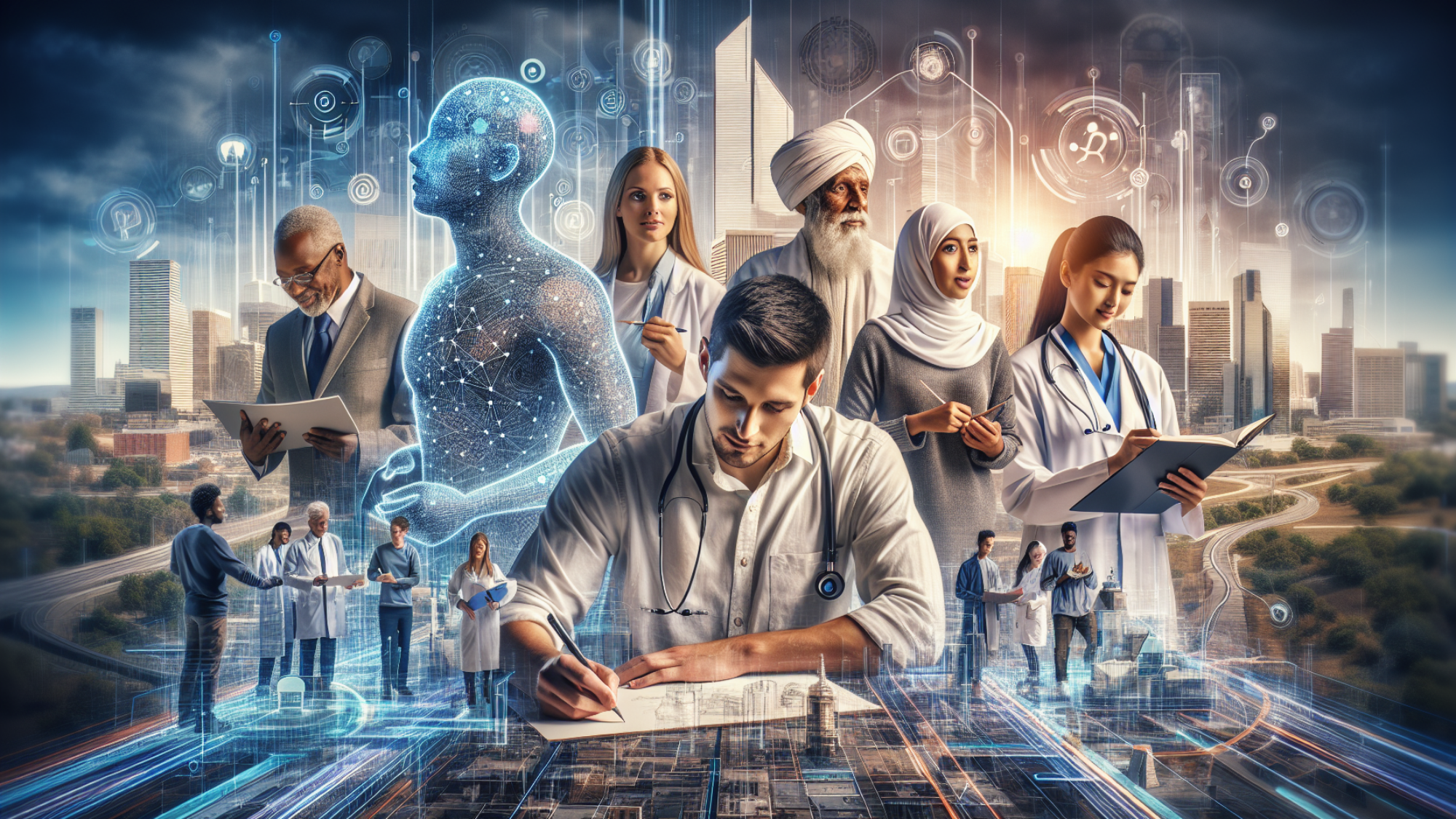
The rise of Artificial Intelligence (AI) has sparked widespread debate, with one question dominating headlines and dinner table conversations: will AI take our jobs?It’s a fear as old as industrialization itself, reimagined for the digital age. While the specter of mass unemployment can be unsettling, a closer look reveals a more nuanced reality. The relationship between AI and human employment is less about outright replacement and more about a profound transformation – a shift that demands adaptability, new skills, and a forward-thinking approach from individuals, businesses, and governments alike.
This isn’t to say there won’t be disruption. AI excels at tasks that are repetitive, data-intensive, and rule-based. These are the areas where we’ve already seen, and will continue to see, significant changes. However, AI also acts as a powerful augmentation tool, enhancing human capabilities and paving the way for entirely new roles and industries. Understanding this dynamic is key to navigating the evolving landscape of work.
The Automation Wave: Where AI Shines
AI’s inherent strengths lie in its ability to process vast amounts of data, identify patterns, and execute tasks with speed and precision far beyond human capacity. This makes it a natural fit for automating specific types of work.
Repetitive and Routine Tasks
Jobs involving highly repetitive physical or cognitive tasks are prime candidates for automation. Think about assembly line workers, data entry clerks, and even certain administrative roles. Robots can perform manufacturing tasks with consistent quality and speed, while AI-powered software can accurately process invoices, manage inventories, and handle routine customer inquiries. This isn’t just about efficiency; it also often reduces human error and frees up human workers from monotonous, sometimes dangerous, work.
Data Analysis and Prediction
AI algorithms are exceptionally good at sifting through mountains of data to uncover insights and make predictions. In finance, AI can analyze market trends to inform investment strategies. In healthcare, it can assist in diagnosing diseases earlier by analyzing medical images or patient records. For businesses, AI can predict consumer behavior, optimize supply chains, and personalize marketing efforts. These are areas where AI doesn’t just replace, but often performs tasks that were previously impossible for humans due to the sheer volume and complexity of data.
According to the World Economic Forum’s (WEF) Future of Jobs Report 2023, AI adoption is projected to create 69 million new jobs while eliminating 83 million, resulting in a net decrease of 14 million jobs globally by 2027. This highlights the double-edged nature of AI – both a destroyer and creator of roles, with the balance shifting rapidly.
Beyond Displacement: AI as an Ally
While some jobs or portions of jobs will undoubtedly be automated, AI’s greater potential lies in its capacity to augment human intelligence and creativity, leading to entirely new forms of work and increased productivity across various sectors.
Augmenting Human Capabilities
Imagine a doctor leveraging AI to quickly analyze complex medical scans for subtle anomalies, allowing them to focus more on patient interaction and personalized care. Or a lawyer using AI to sift through thousands of legal documents, drastically cutting down research time and freeing them to focus on strategy and advocacy. AI acts as a sophisticated tool, an assistant that handles the grunt work, provides insights, and helps humans make better, faster decisions. This “cobot” (collaborative robot) or “centaur” (human + AI) model significantly boosts human productivity and enables us to tackle more complex challenges.
Creating New Job Categories
Every technological revolution has not only displaced old jobs but also created new ones. The internet, for example, rendered many traditional roles obsolete but birthed an entire digital economy. Similarly, AI is generating demand for a range of new professions. We now need AI developers and engineers, data scientists to manage and interpret AI outputs, AI ethics specialists to ensure responsible deployment, prompt engineers to communicate effectively with large language models, and AI trainers to fine-tune algorithms. These roles require a unique blend of technical expertise, critical thinking, and often, an understanding of human behavior and societal impact.
Sectors in Transformation: A Closer Look
The impact of AI will vary significantly across different industries, leading to diverse transformations.
Manufacturing and Logistics
Automation has been a staple here for decades, and AI is taking it to the next level. Robots are becoming more agile and adaptable, working alongside humans in assembly lines. AI-powered analytics optimize supply chains, predict equipment failures, and manage inventory more efficiently. Human roles are shifting from manual labor to supervision, maintenance, programming, and strategic planning.
Customer Service and Administration
Chatbots and virtual assistants can now handle a vast array of customer queries, from troubleshooting to order tracking. This doesn’t necessarily mean the end of human customer service but rather a reallocation of resources. Human agents can now focus on complex, emotionally charged issues, where empathy and nuanced problem-solving are paramount. Similarly, administrative AI can manage schedules, process expenses, and draft routine communications, freeing up human assistants for more strategic support.
Creative and Professional Fields
Even professions thought to be immune to automation, like writing, graphic design, and software development, are seeing AI integration. AI tools can generate first drafts of articles, create design concepts, or write basic code. For professionals, this means AI becomes a co-creator or an efficiency booster, handling the tedious parts of the creative process and allowing humans to focus on higher-level creativity, strategy, and injecting unique human perspective and emotion.
Healthcare and Education
In healthcare, AI assists with diagnostics, drug discovery, and personalized treatment plans, making healthcare more precise and accessible. In education, AI-powered platforms can offer personalized learning experiences, grade assignments, and identify struggling students. In both cases, human professionals become more effective, dedicating more time to direct patient care, mentorship, critical thinking instruction, and fostering social-emotional development.
The Human Edge: Skills for the AI Era
While AI handles data and logic with unparalleled efficiency, there remains a core set of human attributes that are difficult, if not impossible, for current AI to replicate. These are the skills that will define success in an AI-augmented world.
- Critical Thinking and Problem-Solving: AI can present solutions based on data, but humans must critically evaluate those solutions, understand their implications, and apply judgment in complex, ambiguous situations.
- Creativity and Innovation: While AI can generate novel combinations, true innovation often stems from human intuition, divergent thinking, and the ability to connect seemingly unrelated ideas in groundbreaking ways.
- Emotional Intelligence and Interpersonal Skills: Empathy, persuasion, negotiation, and the ability to build meaningful relationships are uniquely human. These skills are crucial in leadership, customer relations, healthcare, education, and any field requiring nuanced human interaction.
- Adaptability and Lifelong Learning: The pace of technological change means that constant learning and a willingness to adapt to new tools and roles will be essential for career longevity.
- Ethical Reasoning: As AI systems become more powerful, the need for human oversight and ethical decision-making in their design and deployment becomes paramount.
Navigating the Future: Strategies for Individuals and Organizations
To thrive in the AI job revolution, proactive steps are needed from all stakeholders.
- For Individuals: Embrace continuous learning. Focus on developing “human-centric” skills that AI struggles with. Seek out training in AI tools relevant to your field. View AI as a collaborator, not just a competitor.
- For Organizations: Invest in reskilling and upskilling your workforce. Foster a culture of learning and adaptation. Integrate AI strategically, aiming to augment human capabilities rather than simply replace roles. Develop clear ethical guidelines for AI use.
- For Governments and Educators: Reform educational systems to emphasize critical thinking, creativity, and digital literacy from an early age. Implement policies that support workers transitioning between roles and industries. Invest in research and development for beneficial AI applications.
Embracing the AI-Augmented Future
The question isn’t whether AI will replace human jobs, but how it will reshape them. History teaches us that technological advancements rarely lead to permanent, widespread unemployment. Instead, they shift the demand for skills and create new opportunities. The AI revolution is not an exception. It’s an invitation to redefine human work, to offload the mundane, and to elevate our focus on creativity, connection, and complex problem-solving. By embracing lifelong learning and developing uniquely human capabilities, we can move beyond fear and position ourselves to thrive in an AI-augmented future.
What steps are you taking to prepare for the AI-augmented future? How do you see AI transforming your industry or career path? We encourage you to explore new learning opportunities and engage in discussions about shaping a future where humans and AI collaborate for mutual benefit.