
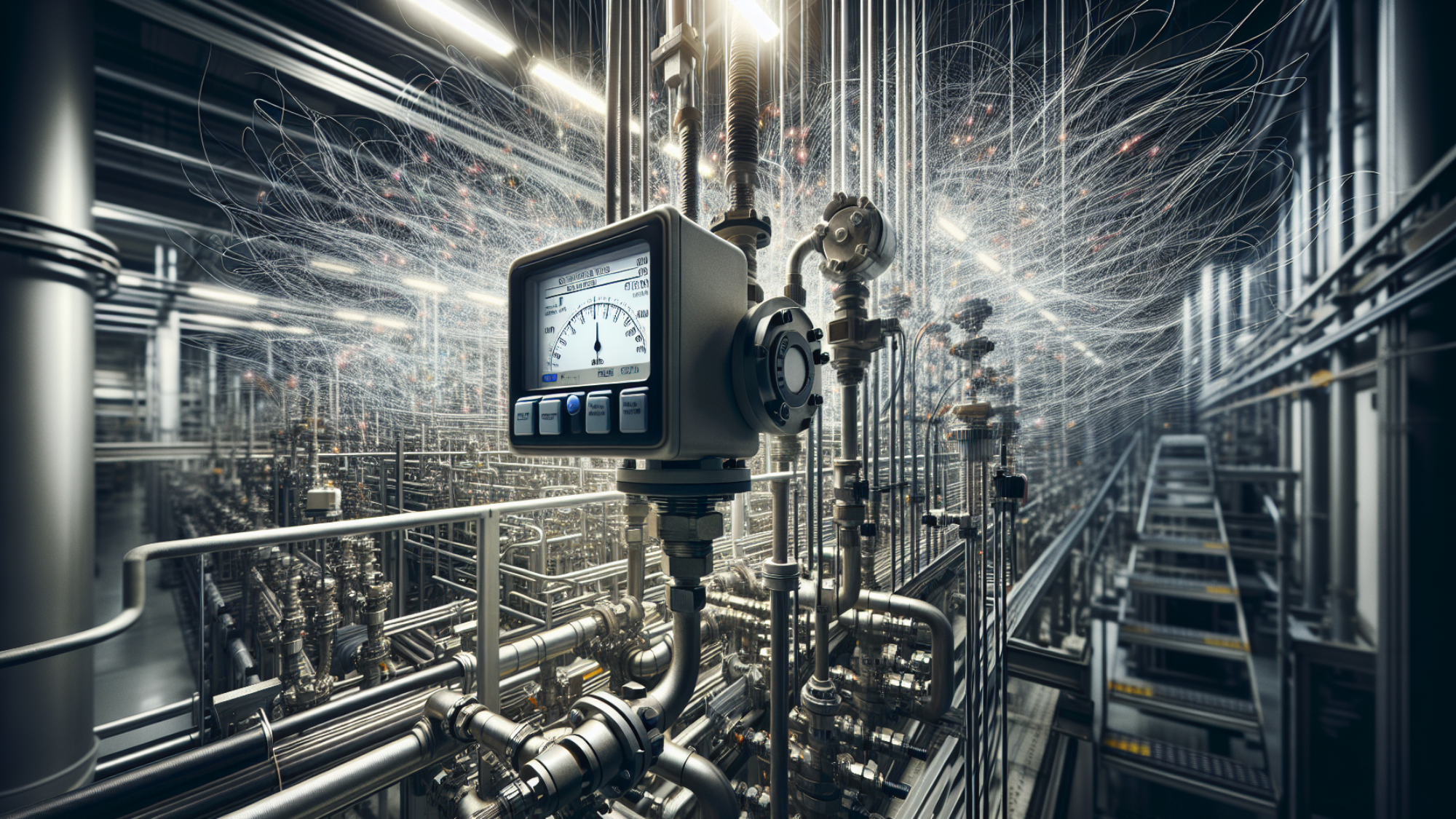
In the complex symphony of an industrial plant, every instrument plays a critical role. Flow sensors, for instance, are the ears of many processes, providing vital feedback to control valves that regulate the movement of liquids and gases. But what happens when those ears pick up static instead of clear instructions? A subtle yet insidious issue: signal noise. This invisible saboteur can quietly degrade control quality, causing everything from minor irritations like actuator wear to significant process upsets and efficiency losses.
Consider the common scenario: a control valve oscillates slightly without any real change in flow, an almost imperceptible jitter that, over time, translates to premature wear, increased energy consumption, and a less stable process. Often, the culprit isn’t a faulty sensor or a malfunctioning valve, but rather invisible electromagnetic interference (EMI) or other forms of signal noise infiltrating the sensor’s delicate wiring. It’s a problem that often goes overlooked, overshadowed by more obvious equipment failures, yet its cumulative impact on operational efficiency and maintenance costs can be substantial.
The Silent Intruder: Understanding Signal Noise
At its core, signal noise refers to any unwanted electrical or electronic disturbance that interferes with the integrity of a signal. For a flow sensor, this means stray voltages or currents that get superimposed on the actual measurement signal, distorting it and presenting false data to the control system. This “noisy” signal then prompts the control valve to react inappropriately, leading to erratic behavior rather than smooth, precise adjustments.
Think of it like trying to have a clear conversation on a phone line filled with static. While you might still get the gist, misunderstandings are inevitable, and the conversation becomes far less efficient. In industrial automation, these “misunderstandings” translate directly into operational inefficiencies and maintenance headaches.
Common Culprits Behind Flow Sensor Noise
Signal noise isn’t a single entity; it has many sources, each requiring a specific approach to mitigation. Identifying the source is often the first and most challenging step in resolving the issue.
- Electromagnetic Interference (EMI): This is perhaps the most prevalent and insidious form of noise in industrial settings. High-power electrical equipment, especially Variable Frequency Drives (VFDs), large motors, welders, and even power lines, generate powerful electromagnetic fields. If sensor wiring runs too close to these sources, these fields can induce unwanted currents and voltages, corrupting the low-voltage sensor signal.
- Radio Frequency Interference (RFI): Similar to EMI, RFI comes from high-frequency sources like wireless communication devices, walkie-talkies, cellular phones, and broadcast transmitters. While often less pervasive than EMI, RFI can cause sporadic and unpredictable signal corruption.
- Ground Loops: These occur when there are multiple paths to ground, creating unintended voltage differences that can induce currents in signal wiring. Improper grounding practices are a significant source of noise and can be notoriously difficult to track down.
- Electrical Noise from Power Supplies: Fluctuations, ripple, or transients in the power supply feeding the sensor or its conditioning electronics can directly translate into noise on the signal output. Faulty power supplies or insufficient filtering are often to blame.
- Mechanical Vibration: While not electrical, excessive vibration can physically stress sensor components or wiring connections, leading to intermittent contact issues that manifest as electrical noise or signal dropouts.
- Poor Wiring Practices: Unshielded cables, improper termination, damaged insulation, or running signal wires parallel to high-current power cables for extended distances significantly increase the susceptibility to noise.
How Noise Undermines Valve Control and Plant Efficiency
The effects of signal noise on flow sensor readings and subsequent valve control are far-reaching, often resulting in a cascade of negative consequences:
- Valve Oscillation and Hunting: The most direct impact is erratic valve movement. Instead of maintaining a stable position, the valve “hunts” or oscillates, constantly trying to correct for non-existent flow changes detected from the noisy sensor signal. This can lead to excessive actuator wear, significantly shortening the lifespan of expensive control valves.
- Reduced Control Loop Performance: Noisy signals introduce instability into the control loop, making it difficult for PID controllers to achieve precise regulation. This results in sluggish response, overshoots, undershoots, and an overall degradation of process control quality.
- Inaccurate Flow Measurements: Beyond valve control, noisy flow signals provide incorrect data to operators and historians, making it challenging to accurately monitor, analyze, and optimize processes. This can lead to incorrect batching, inefficient material usage, and faulty performance metrics.
- Process Upsets and Off-Spec Product: In sensitive applications like chemical dosing, water treatment, or food processing, even minor inaccuracies caused by noise can lead to off-spec product, increased waste, and potentially costly reprocessing or disposal. Studies indicate that unplanned downtime, often stemming from such subtle issues, can cost manufacturers anywhere from $10,000 to $50,000 per hour, depending on the industry and scale.
- Increased Energy Consumption: Continuously oscillating valves and pumps working harder to compensate for unstable conditions consume more energy than necessary, directly impacting operational costs.
Diagnosing the Invisible Threat
Detecting signal noise often requires a systematic approach and specialized tools:
- Oscilloscope: This is an invaluable tool for visualizing the actual sensor signal. By observing the waveform, technicians can identify spikes, ripples, or erratic fluctuations that indicate noise.
- Data Logging and Trend Analysis: Monitoring the sensor’s output over time can reveal intermittent noise patterns that might not be obvious during a quick spot check. Look for sudden, inexplicable spikes or dips that don’t correlate with actual process changes.
- Systematic Isolation: Temporarily disconnecting or bypassing suspected noise sources (e.g., turning off nearby VFDs if safe to do so) can help pinpoint the culprit.
- EMF Detectors: Handheld devices that detect electromagnetic fields can help locate strong EMI sources near sensor wiring.
- Thorough Wiring Inspection: Physically inspecting all cabling for damage, proper shielding, grounding, and separation from power cables is crucial.
Practical Strategies for Noise Mitigation
Once identified, mitigating signal noise requires a combination of best practices in design, installation, and maintenance.
- Proper Shielding: Employing shielded cables (foil, braid, or both) for sensor signals is fundamental. The shield acts as a Faraday cage, diverting external electromagnetic fields to ground. Crucially, shields must be properly grounded, ideally at only one end (the control system end) to prevent ground loops.
- Effective Grounding: Implement a robust single-point grounding scheme for instrumentation. This prevents multiple ground paths that can create ground loops. Ensure all ground connections are clean, secure, and have low impedance.
- Cable Separation and Routing: This is one of the simplest yet most effective measures. Always route low-voltage signal cables separately from high-voltage power cables. Maintain minimum separation distances as recommended by industry standards (e.g., NEMA, ISA). If they must cross, do so at a 90-degree angle to minimize inductive coupling.
- Twisted Pair Wiring: For analog signals, using twisted pair cables helps cancel out common-mode noise. Any noise induced on one wire of the pair will be similar to that induced on the other, allowing differential inputs to reject it.
- Signal Conditioners and Filters: In persistent cases, active signal conditioners with built-in filtering (e.g., low-pass filters, ferrite beads) can effectively clean up a noisy signal before it reaches the control system. Ferrite beads can be clamped onto existing cables to absorb high-frequency noise.
- Optical Isolation: For highly critical signals or in extremely noisy environments, optical isolators can provide complete electrical separation between the sensor and the control system, eliminating conductive noise paths.
- Regular Maintenance and Training: Periodically inspect wiring, grounding points, and cable routing. Train maintenance personnel on the importance of signal integrity and best practices for installation and troubleshooting.
The ROI of Signal Integrity
Investing in signal integrity isn’t just about fixing a problem; it’s about proactive optimization. By mitigating signal noise, plants can expect:
- Extended lifespan of control valves and actuators.
- More stable and precise process control.
- Reduced energy consumption.
- Fewer process upsets and less off-spec product.
- Accurate data for better operational insights and decision-making.
- Overall improvements in plant efficiency, reliability, and safety.
In the fast-paced world of industrial automation, where every percentage point of efficiency matters, overlooking the subtle impact of signal noise is a costly mistake. By understanding its sources, diligently diagnosing its presence, and implementing robust mitigation strategies, plant operators can ensure their flow sensors provide clear, reliable feedback, leading to optimal valve control and a significantly healthier bottom line.
Is your plant quietly battling the effects of signal noise? Don’t let invisible disruptions compromise your control loops. Take a proactive approach to signal integrity today and unlock new levels of operational excellence. Contact our experts to discuss how to assess and improve your plant’s sensor signal health.