
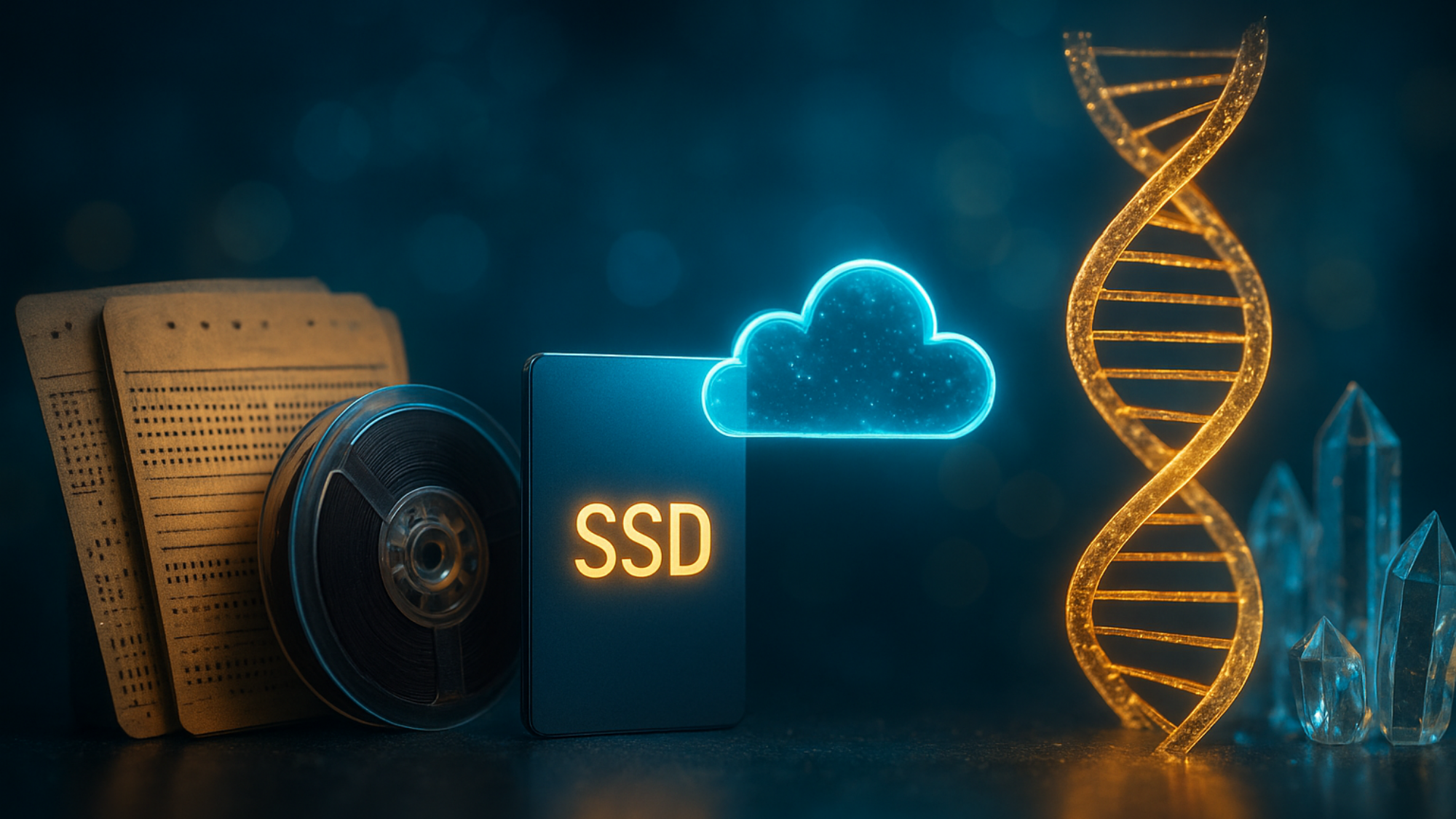
Imagine a world where a single high-resolution photograph takes up more physical space than an entire room of filing cabinets. It sounds like science fiction, but for the pioneers of computing, this was a daily reality. Every time we click “save,” upload a video to the cloud, or transfer a file via a lightning-fast NVMe drive, we are benefiting from a century of intense engineering breakthroughs.
The journey of data storage is not just a story of smaller devices; it is a story of exponential growth in density, speed, and accessibility. We have transitioned from physically punching holes in paper to encoding information within the very building blocks of life itself. To understand where we are going, we must first look back at the mechanical foundations upon which our digital world was built.
The Mechanical Era: Punch Cards and Magnetic Tapes
In the early days of computing, “storage” was a tactile, physical process. Before the invention of the semiconductor, data was represented by physical changes to a medium. The most iconic of these were punch cards. Used extensively in the 19th century for census data and later adopted by early computers like the IBM machines, punch cards stored information by punching holes in specific patterns. While revolutionary, they were incredibly inefficient. A single error in a card could derail an entire computation, and the sheer volume of cards required to store even basic programs made scaling nearly impossible.
As the mid-20th century approached, the industry moved toward magnetic storage. Magnetic tape emerged as the first real way to store large amounts of data sequentially. While tape offered much higher density than punch cards, it had a significant drawback: you couldn’t “jump” to a specific piece of data. If you needed a file at the end of the tape, you had to physically wind through the entire reel. This sequential access was a massive bottleneck for the burgeoning field of real-time processing.
The Rise of the Hard Disk Drive (HDD)
The true turning point for modern computing came with the advent of “random access” storage. In 1956, IBM introduced the RAMAC 305, the first commercial hard disk drive. It was a behemoth—the size of two large refrigerators—and it could only store about 5 megabytes of data. By today’s standards, that isn’t even enough to hold a single high-quality smartphone photo.
However, the concept was transformative. For the first time, a computer could access any piece of data on the disk almost instantly, without waiting for a tape to wind. This technology evolved rapidly through the decades:
- The 1970s-80s: Hard drives shrunk from room-sized machines to components that could fit inside a desktop PC.
- The 1990s: The capacity jumped from megabytes to gigabytes, fueled by the rise of the personal computer revolution.
- The 2000s: Hard drives became the backbone of the internet, enabling the massive data centers that would eventually power the web.
The Portability Revolution: Floppies, CDs, and USBs
As computers entered the homes of the masses, the need for portable storage became paramount. We saw the rise of the floppy disk—a fragile but essential tool for transferring software and documents. While the 3.5-inch floppy eventually became a household name, its limited capacity (often just 1.44 MB) meant it quickly became obsolete as file sizes grew.
The industry then pivoted to optical storage. The Compact Disc (CD), followed by the Digital Versatile Disc (DVD) and the Blu-ray, used laser technology to read data from a spinning disc. This allowed for much higher density and was the primary medium for music, movies, and software distribution for nearly two decades. This was eventually superseded by the USB flash drive, which utilized NAND flash memory to provide a rugged, high-speed, and highly portable alternative to optical media.
The Solid-State Revolution and the Cloud
Today, we live in the era of the Solid State Drive (SSD). Unlike traditional HDDs, which rely on spinning magnetic platters and moving read/write heads, SSDs have no moving parts. They use electrical charges within flash memory cells to store data. This shift has fundamentally changed the performance of modern computing.
The Speed of NVMe
The introduction of NVMe (Non-Volatile Memory Express) technology took this even further. By utilizing the high-speed PCIe bus, NVMe SSDs eliminated the communication bottlenecks that older SATA-based drives faced. This has resulted in:
- Reduced Latency: Near-instantaneous response times for the operating system.
- Massive Throughput: Transfer speeds that can exceed several gigabytes per second.
- Energy Efficiency: Less power consumption, which is critical for the longevity of mobile devices and massive data centers.
The Ubiquity of the Cloud
Parallel to the hardware revolution was the shift in where we store our data. We have moved from local-first storage to a cloud-centric model. Services like AWS, Google Cloud, and Microsoft Azure have democratized data storage. Instead of buying a physical drive, businesses and individuals now rent virtually infinite capacity. According to industry statistics, the amount of data created, captured, and consumed globally is expected to grow into the hundreds of zettabytes in the coming years, a scale that can only be managed through highly distributed, cloud-based architectures.
The Future: Biological and Quantum Frontiers
As we approach the physical limits of how much data we can cram onto silicon chips, scientists are looking toward even more exotic mediums. The next leap in storage will likely move away from traditional electronics entirely.
DNA Data Storage
Perhaps the most mind-blowing frontier is DNA storage. Biological DNA is the most efficient data storage medium in the known universe. It is incredibly dense and can last for thousands of years if kept in the right conditions. Researchers have already successfully encoded books, music, and even entire computer operating systems into synthetic DNA strands. In theory, a single gram of DNA could store hundreds of petabytes of data.
Holographic and Glass Storage
Another contender is holographic storage, which uses light to store data in three dimensions within a crystal or polymer, rather than just on the surface. Additionally, Microsoft’s “Project Silica” is exploring the use of ultrafast lasers to etch data into quartz glass. This glass-based storage is essentially permanent, resistant to electromagnetic pulses, and capable of surviving for millennia without degradation.
Conclusion: A Continuous Cycle of Innovation
The evolution of data storage is a testament to human ingenuity. We have moved from the physical sensation of punching holes in paper to the ethereal realm of cloud computing, and we are now standing on the precipice of a biological and crystalline revolution. As our appetite for data grows—driven by AI, IoT, and high-definition media—our storage solutions must become denser, faster, and more sustainable.
The journey from the massive IBM RAMAC to the microscopic potential of DNA shows us one thing: in the digital age, the only limit to what we can remember is the technology we use to record it.
What do you think is the next big breakthrough in data management? Are you ready for the era of biological storage? Share your thoughts in the comments below!