
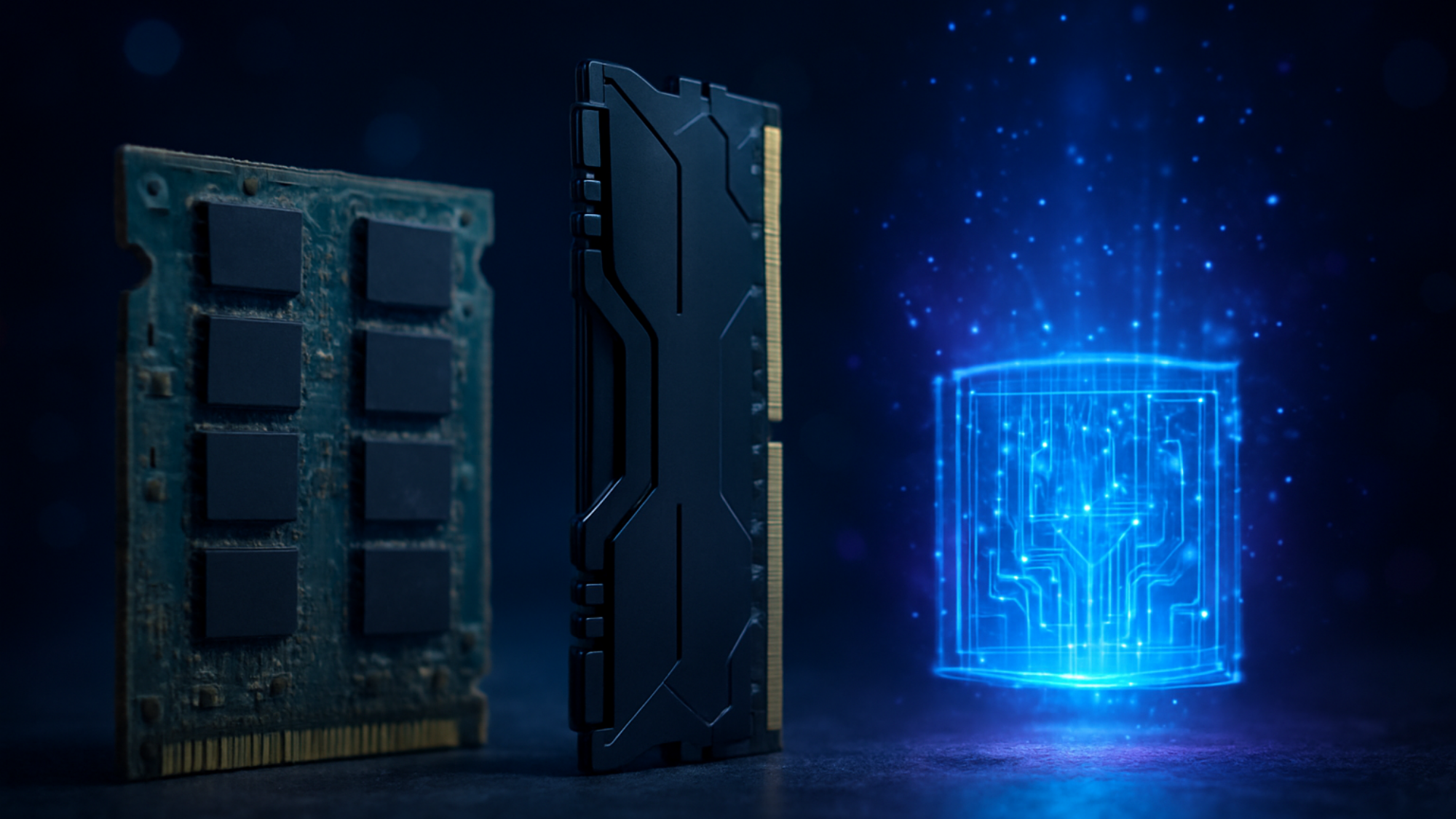
Imagine a world-class chef working in a kitchen. To cook a complex meal, they don’t just need a pantry full of ingredients (your hard drive); they need a massive, clean, and instantly accessible countertop to chop, mix, and prep. If the countertop is too small, the chef slows down, even if the pantry is infinite. In the world of computing, Random Access Memory (RAM) is that countertop.
The journey of RAM is one of the most significant sagas in the history of technology. We have moved from storing mere bytes of data in physical magnetic rings to managing terabytes of information in high-speed silicon pathways. This evolution hasn’t just made computers faster; it has fundamentally redefined what humanity can achieve with digital intelligence.
The Primitive Age: Magnetic Cores and the Era of Bytes
In the early days of computing—think the 1940s and 50s—the concept of “memory” was a physical, mechanical challenge. Before we had the sleek silicon chips we know today, computers relied on magnetic-core memory. These were tiny, microscopic rings of ferrite material threaded onto wires. To store a bit, electricity would magnetize the ring in one direction; to erase it, the direction was reversed.
While revolutionary for its time, this method was incredibly bulky and expensive. The capacity was measured not in gigabytes, but in bits and bytes. A computer with just a few kilobytes of memory would have occupied an entire room. The latency—the time it took to retrieve data—was enormous compared to modern standards, but for the pioneers of the vacuum tube era, it was a miracle of engineering.
The Semiconductor Revolution: The Birth of DRAM and SRAM
The true turning point arrived in the 1970s with the invention of the semiconductor memory. This era saw the emergence of two distinct champions: Static RAM (SRAM) and Dynamic RAM (DRAM).
- SRAM (Static RAM): This type of memory is incredibly fast because it doesn’t need to be constantly “refreshed” to keep its data. However, it is complex and expensive to manufacture, making it ideal for small, high-speed tasks like CPU cache.
- DRAM (Dynamic RAM): This is the workhorse of the computing world. DRAM stores data in capacitors. Because capacitors naturally leak electricity, the data must be “refreshed” thousands of times per second. This makes DRAM much cheaper and denser than SRAM, allowing us to scale capacity significantly.
The introduction of the Intel 1103 chip in 1970 effectively signaled the beginning of the end for magnetic cores, paving the way for the personal computer revolution.
The Synchronous Leap and the Rise of DDR
For decades, memory and processors lived in two different worlds. The processor would run at one speed, and the memory would wait on its own rhythm, often creating a “bottleneck” where the CPU sat idle, waiting for data.
This changed with the introduction of SDRAM (Synchronous Dynamic RAM). By synchronizing the memory’s interface with the system clock, data could be sent in a rhythmic, predictable flow. But the real explosion occurred with the advent of DDR (Double Data Rate) technology.
DDR changed the game by transferring data on both the rising and falling edges of the clock signal. Instead of one transfer per cycle, you got two. This started a generational arms race that has lasted two decades:
- DDR1 & DDR2: Focused on increasing clock speeds and reducing power consumption.
- DDR3: Brought higher densities and better efficiency, becoming the standard for the mid-2000s computing boom.
- DDR4: Introduced much higher bandwidth and lower voltages, enabling the era of multi-core processors and heavy multitasking.
- DDR5: The current frontier. DDR5 doesn’t just increase speed; it fundamentally changes how memory manages itself, offering on-die Error Correction Code (ECC) and significantly higher burst lengths to feed data-hungry modern CPUs.
Scaling to the Extreme: From Megabytes to Terabytes
As our software grew from simple text editors to massive open-world video games and complex 3D rendering engines, our “countertops” had to expand. We moved from the 640KB limit of early DOS systems to the 8GB and 16GB standards common in modern consumer laptops.
However, the demand for RAM isn’t just a consumer phenomenon. In the enterprise and data center sectors, the scale is astronomical. We are no longer talking about sticks of RAM plugged into a motherboard; we are talking about massive arrays of LRDIMMs (Load-Reduced DIMMs) and specialized modules that allow servers to hold several terabytes of RAM in a single chassis.
Why is this necessary? Because modern workloads like Big Data analytics and real-time financial modeling require massive datasets to be loaded entirely into memory to avoid the “slowness” of retrieving data from a disk.
The AI Frontier and High Bandwidth Memory (HBM)
We are currently witnessing the most intense period of memory evolution in history, driven almost entirely by Artificial Intelligence. Large Language Models (LLMs) like the ones powering modern AI require an incredible amount of data to be moved between the processor and the memory almost instantaneously.
Standard DDR5, while fast, can still struggle to keep up with the massive parallel processing required by AI accelerators (like GPUs). This has led to the rise of HBM (High Bandwidth Memory).
Unlike traditional RAM, which sits in slots away from the processor, HBM is stacked vertically in layers and placed directly on the same package as the processor. This drastically reduces the distance data has to travel and provides a “highway” of bandwidth that is orders of magnitude wider than traditional setups. When you see a high-end AI chip boasting hundreds of gigabytes of memory with terabytes per second of bandwidth, you are looking at the pinnacle of current memory evolution.
What Lies Ahead: The Future of Memory
As we approach the physical limits of silicon, engineers are looking toward new frontiers. The evolution will likely follow these paths:
- Non-Volatile Memory (NVM): The holy grail is memory that is as fast as RAM but as permanent as a hard drive. This would mean “instant-on” computers where no data is ever lost when power is cut.
- Optical Computing: Using light (photons) instead of electricity (electrons) to move data could theoretically eliminate heat issues and increase speeds by thousands of percent.
- Quantum Memory: As quantum computing matures, we will need entirely new ways to store “qubits,” which operate on principles fundamentally different from the binary 1s and 0s of today.
The journey from a few magnetic rings to the massive, light-speed architectures of today is a testament to human ingenuity. As our digital ambitions grow, our memory will continue to evolve, ensuring that the “countertop” is always large enough to host the next great leap in human intelligence.