
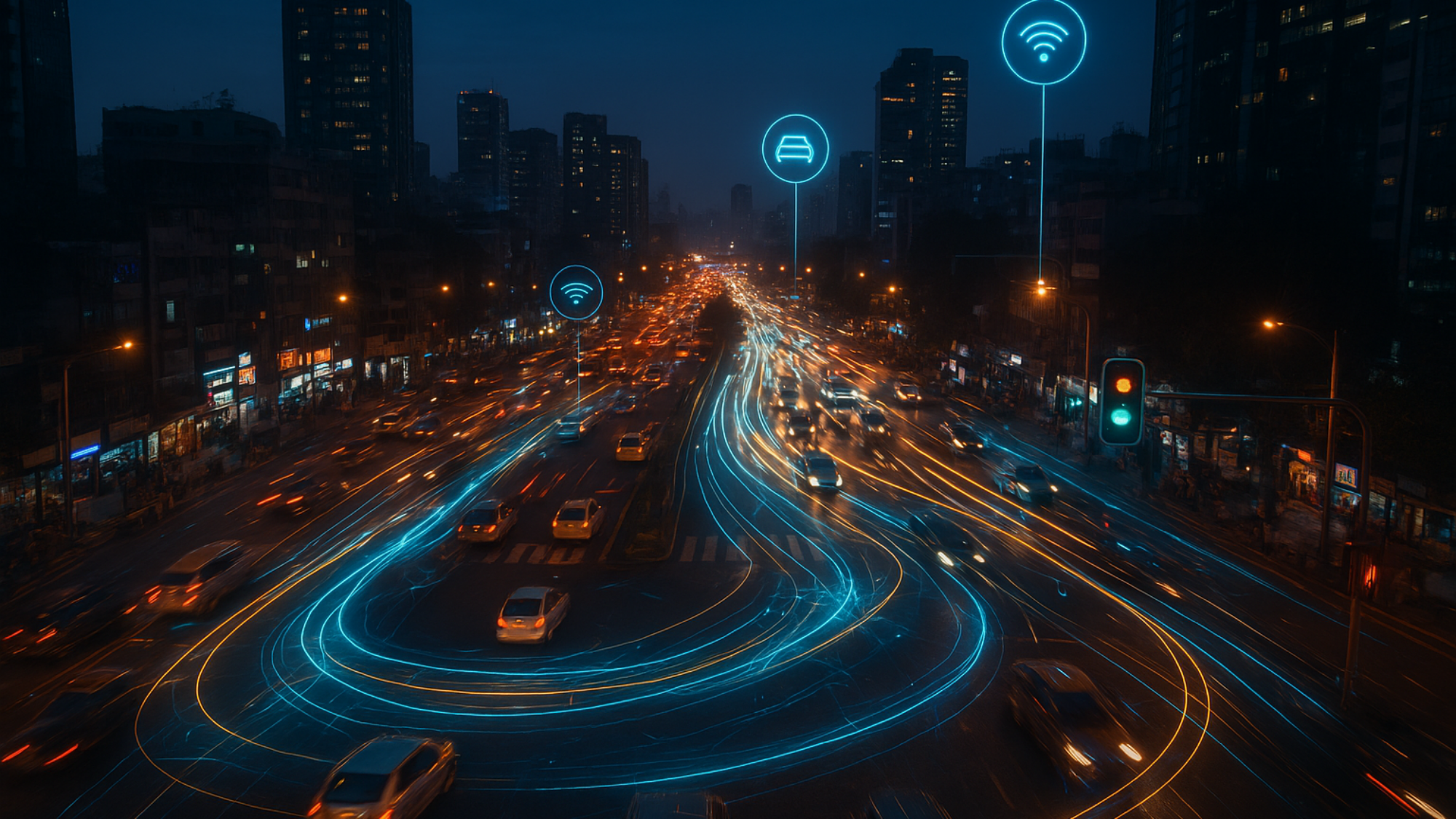
The sound of constant honking, the sight of endless brake lights stretching toward the horizon, and the frustration of a commute that should take twenty minutes but takes two hours—this is the daily reality for millions of urban Indians. As India undergoes one of the fastest urbanizations in human history, our traditional road infrastructures are buckling under the weight of sheer volume. However, a silent revolution is happening in the background. Beyond the asphalt and the concrete, a digital layer is being laid down to manage the chaos. This is the era of Smart Traffic Management Systems (STMS).
STMS is not just about changing traffic lights from red to green; it is an integrated ecosystem of hardware and software designed to optimize the flow of vehicles, pedestrians, and public transport through real-time data. For a country as complex as India, where traffic is a multi-modal dance of cars, auto-rickshaws, two-wheelers, and pedestrians, STMS represents the only viable path toward sustainable urban mobility.
The Mechanics: How STMS Actually Works
To the casual observer, a smart traffic light looks much like a traditional one. But beneath the surface, an STMS functions through a sophisticated “Sense-Analyze-Act” loop. This loop relies on several interconnected technological layers.
1. Data Acquisition (The Sensing Layer)
The first step in any smart system is perception. In an Indian context, this involves a massive array of IoT (Internet of Things) devices. These include:
- CCTV and AI Cameras: High-definition cameras equipped with computer vision can distinguish between different types of vehicles. They don’t just see “movement”; they identify if a lane is clogged with heavy trucks or if a swarm of two-wheelers is attempting to overtake.
- Inductive Loop Sensors: These are wires embedded in the road surface that detect the presence of metal (vehicles) passing over them.
- Radar and LiDAR: These sensors provide highly accurate distance and speed data, even in low-visibility conditions like heavy monsoon rains or thick smog.
2. Data Processing and Intelligence (The Brain)
Once the data is collected, it is transmitted via 5G or dedicated fiber networks to a centralized Command and Control Center (CCC). Here, Artificial Intelligence (AI) and Machine Learning (ML) algorithms take over. The system analyzes historical patterns alongside real-time data. For instance, if the system detects a sudden slowdown on a major artery, it can determine if it is a routine peak-hour buildup or an unexpected accident.
3. Adaptive Response (The Action Layer)
This is where the magic happens. Instead of operating on fixed timers, the system uses Adaptive Signal Control Technology (ASCT). If one side of an intersection is empty while the other has a massive queue, the AI adjusts the signal timing in real-time to clear the congestion. Furthermore, the system can communicate with Variable Message Signs (VMS)—those large digital boards on highways—to divert traffic to alternative routes before a bottleneck becomes a standstill.
The “India Factor”: Why STMS Must Be Unique Here
Implementing STMS in London or Singapore is a vastly different challenge than implementing it in Delhi or Bengaluru. Indian traffic is characterized by “heterogeneous flow.” In most Western cities, lanes are strictly respected, and vehicle types are somewhat uniform. In India, a single lane might contain a luxury sedan, a delivery bike, a slow-moving auto-rickshaw, and a pedestrian, all occupying varying amounts of space.
A successful STMS in India must account for:
- Non-Lane-Based Behavior: Algorithms must be trained to recognize and predict movement that doesn’t follow strict lane discipline.
- Extreme Weather: Sensors must remain functional during torrential monsoons and extreme heat waves.
- High Density: The sheer number of data points generated by millions of commuters requires massive computing power and low-latency connectivity.
Leading the Charge: Top Indian Cities Using STMS
Under the Government of India’s Smart Cities Mission, several metropolitan areas have emerged as pioneers in intelligent transport. While many cities are in various stages of deployment, certain cities stand out for their integration and effectiveness.
1. Bengaluru: The Tech-Driven Approach
As India’s Silicon Valley, Bengaluru has been at the forefront of testing AI-driven traffic solutions. Given its notorious congestion, the city has integrated several smart corridors where real-time monitoring helps manage the flow between the IT hubs of Whitefield and Electronic City. The focus here is heavily on using data to reduce the “travel time uncertainty” that plagues its workforce.
2. Delhi: Managing Scale and Air Quality
The National Capital Region (NCR) presents one of the most complex traffic puzzles in the world. Delhi’s implementation of STMS is uniquely tied to environmental goals. By managing traffic flow more efficiently, the city aims to reduce “idling time”—the period when vehicles sit stationary in traffic—which is a primary contributor to the city’s severe air pollution levels.
3. Hyderabad: The Integrated Model
Hyderabad has been lauded for its seamless integration of smart infrastructure. The city utilizes a robust Command and Control Center that not only manages traffic but also integrates with emergency services. This allows for “Green Corridors,” where STMS can automatically clear a path for ambulances by adjusting signals in real-time, potentially saving countless lives.
4. Pune: The Industrial Corridor
As a major hub for automotive manufacturing and education, Pune’s traffic patterns are highly cyclical. The city has implemented smart signaling to manage the heavy influx of commercial vehicles and the daily surge of student and worker commuters, aiming for a more predictable transit experience.
5. Surat and Indore: The Efficiency Benchmarks
While not as massive as Delhi or Mumbai, these cities have consistently ranked high in the Smart City Index. Their approach to STMS focuses on cleanliness and efficient public transport integration, ensuring that smart traffic management supports their broader goals of operational excellence and urban livability.
The Socio-Economic Impact of Smart Mobility
The transition to STMS is not merely a matter of convenience; it is an economic imperative. According to various urban studies, traffic congestion costs major Indian economies billions of dollars annually in lost productivity, wasted fuel, and increased healthcare costs due to pollution.
By implementing intelligent systems, cities can expect:
- Reduced Fuel Consumption: Less idling means less petrol and diesel wasted.
- Lower Carbon Footprints: Smoother traffic flows directly translate to reduced CO2 emissions.
- Enhanced Emergency Response: Faster transit for ambulances and fire engines.
- Economic Productivity: When people spend less time in traffic, they spend more time working, learning, or with their families.
The Road Ahead: V2X and Beyond
The future of STMS in India lies in Vehicle-to-Everything (V2X) communication. Imagine a world where your car “talks” to the traffic light, knowing exactly when it will arrive, or where a smart intersection warns your vehicle about a pedestrian stepping off a curb around a blind corner. As 5G penetration increases across India, the bandwidth required for such real-time, life-saving communication will become a reality.
The journey from chaotic streets to smart corridors is long, but the blueprint is already being written. Through the marriage of cutting-edge AI and robust urban infrastructure, India is moving toward a future where mobility is no longer a struggle, but a seamless part of urban life.
As we continue to build the cities of tomorrow, the question is no longer whether we can afford to implement Smart Traffic Management Systems, but whether we can afford not to.