
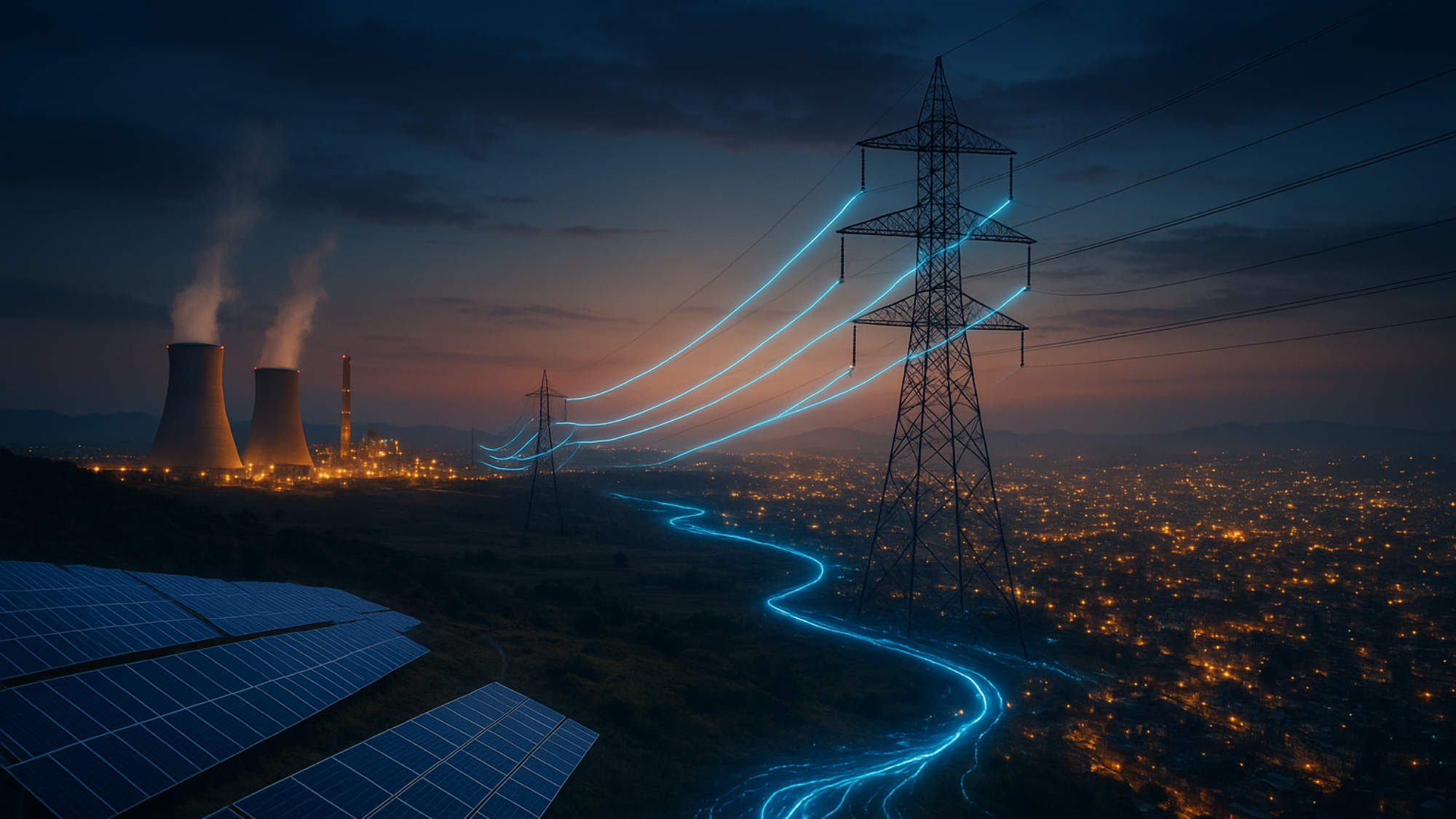
Every time you flip a light switch in Mumbai, charge your smartphone in Bengaluru, or turn on an air conditioner in Delhi, you are participating in one of the most complex engineering feats in the world. Electricity doesn’t just “appear” in your socket; it travels through a massive, multi-layered infrastructure that spans thousands of kilometers and involves several distinct stages of transformation.
In a country as vast and populous as India, managing the flow of electrons requires a delicate balance of massive generation hubs, a high-speed national highway of wires, and a granular network of local distributors. To understand how your home stays powered, we must trace the journey from the roaring turbines of a power plant to the tiny copper wires in your walls.
Phase 1: The Genesis of Power (Generation)
The journey begins at the generation source. In India, electricity is produced through a diverse “energy mix” that combines traditional fossil fuels with rapidly expanding renewable sources.
The Traditional Backbone: Thermal Power
For decades, coal has been the undisputed king of India’s energy sector. Thermal power plants, which burn coal to produce steam that spins massive turbines, still account for a significant portion of the nation’s total installed capacity. While the country is moving toward cleaner alternatives, these massive plants serve as the “baseload” power—the steady, reliable flow of energy required to keep the lights on 24/7.
The Green Revolution: Renewables and Hydro
India is currently undergoing one of the world’s largest energy transitions. Solar and wind energy are no longer just “alternatives”; they are becoming central pillars of the grid. Massive solar parks in Rajasthan and wind farms in Tamil Nadu are pumping clean electrons into the system. Additionally, hydroelectric power—using the force of flowing water—provides a crucial source of both renewable energy and “peaking” power, which can be ramped up quickly when demand spikes.
Nuclear Power
Though it represents a smaller fraction of the total mix, nuclear power provides a high-density, low-carbon source of energy that helps stabilize the grid without the carbon footprint of coal.
Phase 2: The Step-Up (Preparing for the Long Haul)
Once electricity is generated, it is at a relatively low voltage. If we tried to send this low-voltage electricity over hundreds of kilometers, most of it would be lost as heat due to the electrical resistance of the wires. This is known as “line loss.”
To combat this, the electricity passes through a Step-Up Transformer at the power plant site. These massive devices increase the voltage to extremely high levels—often reaching 400kV, 765kV, or even higher. By increasing the voltage, we decrease the current, which significantly reduces the energy lost during long-distance travel. This high-voltage electricity is now ready to enter the “expressway” of the energy world.
Phase 3: The National Grid (Transmission)
India operates under a unique and highly sophisticated framework known as “One Nation, One Grid, One Frequency.” Before this integration, different regions of India operated on somewhat isolated grids. Today, the national grid allows electricity generated in a wind-rich state like Gujarat to be used in a coal-dependent state like Bihar seamlessly.
The Transmission Network
The heavy lifting is done by the Power Grid Corporation of India (PGCIL) and various state-owned transmission utilities. They manage the massive steel towers that march across forests, mountains, and plains. This transmission network acts like the interstate highway system, moving massive “volumes” of electricity from the generation hubs to various regional centers across the subcontinent.
Phase 4: The Step-Down (Substations and Regional Entry)
As the electricity approaches a populated area—be it a city, a town, or a village—it becomes too “powerful” for local use. The high voltage required for long-distance travel would instantly fry household appliances.
The electricity enters a Substation. Here, Step-Down Transformers perform the opposite task of what happened at the power plant. They reduce the voltage to a medium level (typically 33kV or 11kV). This medium-voltage electricity is then routed through the regional transmission lines toward the local distribution network.
Phase 5: The Final Mile (Distribution)
This is where the journey gets granular. The responsibility for getting electricity to your door lies with the DISCOMs (Distribution Companies). These are the entities you interact with most—the ones that send you your monthly bill and manage local power outages.
The Local Transformer
Before the electricity reaches your house, it undergoes one final transformation. You may have seen small, cylindrical metal tanks mounted on electric poles in your neighborhood; these are Distribution Transformers. They take the 11kV medium-voltage electricity and step it down one last time to the standard residential voltage used in India: typically 230V (single-phase) or 400V (three-phase).
The Service Connection
From the local transformer, electricity travels through low-voltage lines to your building’s meter. The meter acts as the final checkpoint, measuring exactly how much energy you consume so the DISCOM can bill you accurately.
The Challenges: Efficiency and Modernization
Despite the incredible engineering, the Indian power sector faces significant hurdles:
- T&D Losses: Technical and Commercial (T&D) losses remain a challenge. Technical losses occur due to the physics of heat in wires, while commercial losses often stem from theft or billing errors.
- Peak Demand Management: As India’s economy grows, so does the demand. Managing the “peak hours”—usually in the early evening when everyone returns home—requires immense grid flexibility.
- Integration of Intermittent Energy: Solar and wind energy are “intermittent” (the sun doesn’t always shine; the wind doesn’t always blow). Integrating these into a stable grid requires advanced storage solutions like massive battery banks.
The Future: Smart Grids and Decentralization
The journey of electricity in India is evolving. We are moving toward a Smart Grid era. Unlike the traditional “one-way” street where power flows from the plant to the home, smart grids allow for “two-way” communication.
With the rollout of Smart Meters, consumers can track their usage in real-time, and utilities can manage demand more intelligently. Furthermore, the rise of rooftop solar is turning many Indian homes from mere “consumers” into “prosumers”—people who both consume and produce electricity, feeding excess power back into the grid.
Understanding this journey reminds us that every flick of a switch is supported by a massive, synchronized dance of physics, engineering, and logistics. As India moves toward a greener, more digitalized energy future, this journey will only become more efficient, cleaner, and more resilient.