
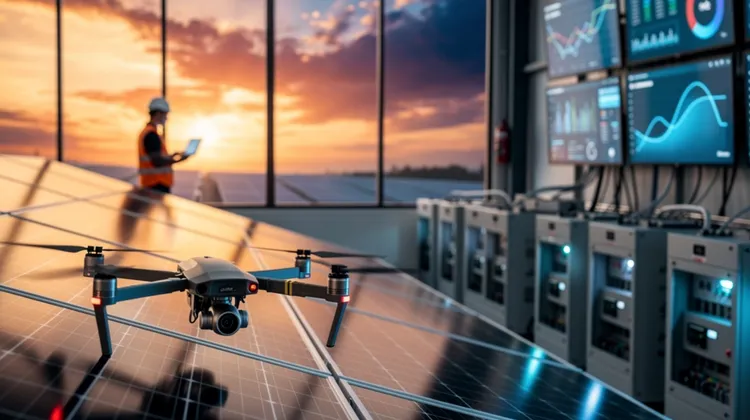
The economics of large-scale photovoltaic (PV) plants hinge on a simple equation: maximize energy output while minimizing operational expenditure. For years, operators have struggled with a reactive maintenance model—fixing panels after they fail or cleaning them on fixed schedules that often miss the mark. This approach is not just inefficient; it is costly. A single undetected hotspot can degrade a panel's performance by 30% or more, while dust accumulation can reduce plant yield by up to 25% in arid regions. The industry has been waiting for a smarter way, and it has finally arrived.
Artificial intelligence is changing the game for solar array maintenance. By integrating computer vision with real-time telemetry, operators can now predict both equipment failures and cleaning requirements with remarkable accuracy. This shift from reactive to predictive maintenance is not an incremental improvement—it is a fundamental transformation in how PV plants are managed, monitored, and maintained.
The Limitations of Traditional Solar Maintenance
Traditional solar O&M practices are built on a foundation of scheduled interventions. Technicians perform thermal inspections quarterly, cleaning crews visit on a rotating basis, and inverter diagnostics are reviewed after alarms trigger. The problem with this model is that it assumes degradation occurs uniformly across a site. It does not.
Solar panels fail for a variety of reasons, each with its own timeline. Microcracks develop from thermal cycling and mechanical stress. Hotspots form when cells become shaded or damaged. Potential-induced degradation (PID) silently reduces output over months. Soiling accumulates at different rates depending on wind patterns, rainfall, and nearby agricultural activity. A fixed maintenance schedule cannot account for these variables.
The financial impact is substantial. According to industry research, undetected faults can cause energy losses of 5% to 10% annually at a typical utility-scale plant. For a 100 MW facility generating 200 GWh per year, that represents 10 to 20 GWh of lost revenue—millions of dollars that vanish due to preventable issues.
How Computer Vision Revolutionizes Fault Detection
Computer vision brings a new level of granularity to solar array monitoring. High-resolution cameras mounted on drones, ground robots, or fixed poles capture detailed imagery of every panel across a site. These images are then processed by AI algorithms trained to identify specific defect patterns.
The technology can detect issues invisible to the naked eye. Thermal cameras reveal hotspots and cell-level failures that appear as temperature anomalies. Electroluminescence imaging exposes microcracks and soldering defects before they become catastrophic. Visual spectrum analysis identifies physical damage, delamination, and discoloration that might otherwise go unnoticed.
What makes this approach truly powerful is its scalability. A single drone flight can capture thousands of images in a few hours, covering an entire 100 MW site. The AI processes these images automatically, flagging anomalies with location data and severity ratings. Technicians receive a prioritized work order list, allowing them to address critical issues first without wasting time on healthy panels.
Real-Time Telemetry: The Data Backbone
While computer vision provides periodic high-resolution snapshots, real-time telemetry delivers continuous operational data. Every inverter, string combiner, and environmental sensor feeds data into a central platform that tracks performance metrics second by second.
The integration of these two data streams is where the magic happens. Computer vision identifies a potential hotspot on panel A-17. Telemetry data reveals that the corresponding string's output has dropped by 8% over the past week. Together, these signals confirm the fault with high confidence. Conversely, telemetry might show a slow performance decline across a section of the array, prompting a targeted drone inspection to identify the root cause.
This fusion of visual and operational data creates a complete picture of plant health. Predictive algorithms analyze historical patterns to forecast when a panel is likely to fail, allowing operators to schedule replacements during planned downtime rather than emergency callouts.
Predictive Cleaning Schedules
Soiling is one of the most significant operational challenges for solar plants, particularly in dusty or arid environments. Traditional cleaning schedules are often based on calendar dates or rough estimates of soiling losses. AI changes this by enabling condition-based cleaning.
Computer vision can quantify soiling levels on individual panels with remarkable precision. Drones capture images that are analyzed to determine the percentage of surface area covered by dust or debris. Combined with telemetry data on power output and weather forecasts, these insights allow operators to optimize cleaning schedules.
The benefits are twofold. First, plants avoid the yield losses associated with excessive soiling. Second, they reduce cleaning costs by eliminating unnecessary washes. A study published in the journal Solar Energy found that AI-optimized cleaning schedules can reduce water consumption by up to 30% while maintaining higher average output than fixed schedules.
The Role of Edge Computing
The sheer volume of data generated by modern PV plants makes cloud-only processing impractical. A single thermal inspection flight can generate 10,000 images, each requiring analysis. Sending all this data to the cloud introduces latency and bandwidth costs that undermine the value of real-time monitoring.
Edge computing solves this problem by processing data locally, at or near the point of collection. Cameras and sensors are equipped with AI chips that can run inference models directly on the device. This allows for immediate detection of anomalies and rapid response to critical faults.
The result is a hybrid architecture that balances speed with depth. Edge devices handle time-sensitive detection tasks, while cloud platforms provide comprehensive analytics, historical trending, and fleet-wide comparisons.
Case Study: Utility-Scale Implementation
A 200 MW solar plant in the Middle East implemented an AI-driven predictive maintenance system combining drone-based computer vision with real-time telemetry. The results were dramatic. Within the first year, the plant reduced unplanned downtime by 45% and increased annual energy yield by 3.2%.
The system identified 127 microcrack instances that would have gone undetected with traditional quarterly thermal inspections. It also optimized cleaning schedules, reducing water usage by 25% while maintaining panel efficiency above 99% of baseline. The return on investment was achieved in less than 14 months.
Overcoming Implementation Challenges
Adopting AI-driven predictive maintenance is not without challenges. The initial investment in drone hardware, camera systems, and analytics platforms can be significant. Many plants also lack the in-house expertise to deploy and manage these technologies.
However, the market is responding. Several major O&M providers now offer predictive maintenance as a service, reducing the upfront cost barrier. Standardized protocols and open data formats are also making integration easier, allowing plants to adopt AI capabilities without replacing their existing monitoring infrastructure.
Data quality is another consideration. AI models are only as good as the training data they receive. Plants with diverse panel types, mounting configurations, and environmental conditions need models trained on representative datasets. This is increasingly being addressed through industry collaborations and shared benchmark datasets.
The Future of Solar Array Maintenance
The integration of AI into solar maintenance is still in its early stages, but the trajectory is clear. As computer vision algorithms become more sophisticated and telemetry systems more granular, predictive accuracy will continue to improve. We are moving toward a future where every panel in a PV plant is monitored individually, with maintenance actions triggered by data rather than schedules.
The implications extend beyond solar arrays. The same principles apply to wind turbines, battery storage systems, and other critical infrastructure. The predictive maintenance revolution is not limited to one technology—it is a fundamental shift in how we approach asset reliability.
For solar plant operators, the message is straightforward. AI-driven predictive maintenance is no longer a luxury for early adopters. It is becoming a competitive necessity, delivering measurable gains in yield and reliability that directly impact the bottom line. The technology is proven, the economics are compelling, and the tools are available today. The only question is which operators will embrace it first.