
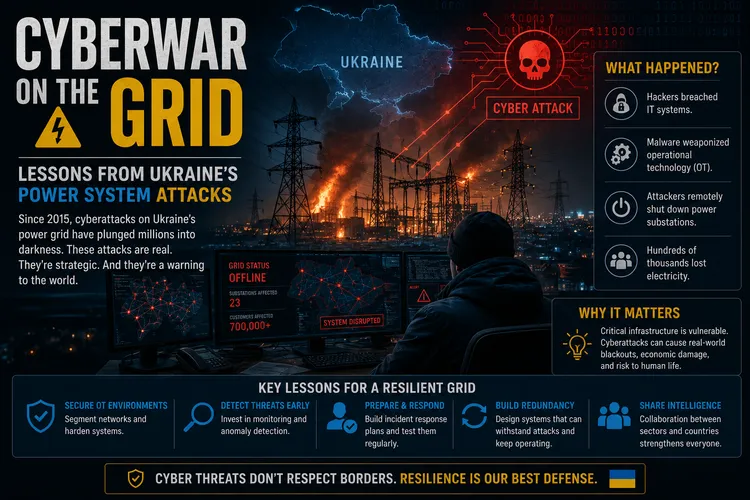
The lights flickered, then died. For hundreds of thousands of Ukrainians, this wasn't just an inconvenience; it was a chilling glimpse into the future of warfare. Over the past decade, Ukraine's power grid has become a critical battleground in the ongoing geopolitical struggle, demonstrating the profound and often devastating impact of cyberattacks on essential infrastructure. These incidents, particularly those documented in 2015, 2016, and escalating during the 2022 full-scale invasion, serve as a stark global warning about the vulnerabilities inherent in our interconnected world.
Ukraine has inadvertently become a proving ground for advanced cyber warfare tactics, with its energy sector bearing the brunt of nation-state-sponsored attacks. Understanding these events is crucial, not just for cybersecurity professionals, but for anyone who relies on the seamless operation of modern utilities – which, let's face it, is everyone.
A New Era of Cyber Warfare: The Early Attacks (2015-2016)
The world truly woke up to the threat of cyberattacks against critical infrastructure on December 23, 2015. On that day, a sophisticated cyber operation successfully targeted multiple Ukrainian energy companies, leading to widespread power outages affecting approximately 225,000 customers. This was the first publicly acknowledged cyberattack to directly cause a power outage. The malware responsible, dubbed BlackEnergy3, used a multi-stage approach. Attackers gained initial access through spear-phishing emails, then moved laterally across IT networks to reach the operational technology (OT) systems that control industrial processes. They manipulated SCADA (Supervisory Control and Data Acquisition) systems, remotely opening circuit breakers and effectively shutting down substations. To hinder recovery efforts, they also deployed a destructive 'wiper' module to erase data on affected systems.
Just a year later, in December 2016, Ukraine faced another, even more advanced attack. This time, a new piece of malware known as Industroyer (also called CrashOverride) was deployed. Industroyer was specifically designed to interact with industrial control systems protocols, making it incredibly potent and versatile for disrupting grid operations. It was capable of communicating directly with protection relays, the digital "brains" of substations, and could issue commands to open and close breakers, potentially causing cascading failures or even physical damage. While the impact was less widespread than in 2015, affecting a portion of Kyiv, the sophistication of Industroyer marked a significant escalation in cyber weapon development, proving that attackers could now build tools tailored precisely for industrial disruption.
The 2022 Invasion and Escalation
With the full-scale invasion of Ukraine in February 2022, cyberattacks became an integral part of the broader military campaign. These weren't isolated incidents but part of a coordinated effort, often preceding or accompanying kinetic military strikes. While detailed attribution is often challenging in real-time, numerous cybersecurity firms and government agencies have documented a continuous barrage of cyber activity targeting Ukraine's critical infrastructure.
One notable incident involved the attempted deployment of Industroyer2 against a major Ukrainian energy provider in April 2022. This updated variant of the infamous malware aimed to disrupt high-voltage electrical substations. Although Ukrainian defenders, in collaboration with international partners, were able to detect and mitigate the attack before it caused widespread outages, its deployment underscored the persistent threat and the attackers' continued investment in specialized OT malware. Beyond Industroyer2, various other wipers (e.g., CaddyWiper, HermeticWiper) and destructive malware have been used against government and critical infrastructure entities, aiming to sow chaos, disrupt communications, and impede the Ukrainian defense effort. IBM's 2023 X-Force Threat Intelligence Index reported that critical infrastructure was the most targeted industry in 2022, accounting for nearly 20% of all attacks globally, largely influenced by the activity surrounding the conflict in Ukraine.
Tactics and Malware Employed
The attacks on Ukraine's power grid have showcased a sophisticated playbook, combining traditional IT infiltration with specialized OT exploitation:
- Spear-phishing: This remains a primary initial access vector. Malicious emails tailored to specific individuals or departments are used to deliver malware, steal credentials, or trick employees into granting access.
- Supply Chain Attacks: Leveraging trusted third-party software or hardware to gain access to target systems.
- Living Off The Land (LOTL): Using legitimate system tools and functionalities to navigate networks and execute commands, making detection harder.
- Custom-built Malware: Beyond BlackEnergy and Industroyer variants, attackers have deployed a range of custom tools for reconnaissance, credential theft, lateral movement, and ultimately, disruption.
- Wiper Malware: Designed to destroy data and render systems inoperable, often used to impede recovery efforts after a primary attack.
- Exploiting IT/OT Convergence: As IT and OT networks become more interconnected for efficiency, they also create new pathways for attackers to bridge the gap between enterprise systems and industrial controls.
Impact on the Ground
The consequences of these attacks extend far beyond temporary power outages. They create a climate of fear and uncertainty, test the resilience of an entire nation, and have significant humanitarian implications, especially during wartime winters. While Ukrainian defenders have shown remarkable resilience and skill in mitigating many attacks, the constant threat places immense strain on personnel and resources.
Moreover, these incidents disrupt essential services, affecting hospitals, communication networks, transportation, and water supply – all of which depend on a stable power source. The blended nature of kinetic and cyber attacks during the 2022 invasion means that physical damage to infrastructure can be exacerbated by cyber means, making repairs and recovery even more challenging.
Global Implications and Lessons Learned
The Ukrainian experience offers invaluable, albeit sobering, lessons for governments, businesses, and cybersecurity professionals worldwide:
- Critical Infrastructure is a Prime Target: The attacks highlight that critical infrastructure – energy, water, transportation, healthcare – is no longer just a theoretical target for cyber warfare; it is a live one. Every nation, city, and company operating such infrastructure must assume they are potential targets.
- The Blurring Lines of War: The Ukraine conflict demonstrates a future where cyber and kinetic warfare are inextricably linked, complementing each other to achieve strategic objectives. Defensive strategies must account for this hybrid threat.
- Enhanced Cybersecurity Posture is Non-Negotiable:
- Proactive Threat Intelligence: Sharing and acting upon threat intelligence is vital. Collaboration between government agencies, private sector security firms, and international partners can provide early warnings.
- Robust Incident Response Plans: Organizations must have well-rehearsed incident response and disaster recovery plans, specifically tailored for OT environments. Knowing how to detect, contain, and recover from an attack quickly can minimize damage.
- Segmenting IT and OT Networks: While full air-gapping might not always be feasible, strong segmentation between IT and OT networks is crucial to prevent attackers from easily moving from less secure enterprise systems to critical industrial controls.
- Multi-Factor Authentication (MFA) and Zero Trust: Implementing MFA across all systems and adopting a "never trust, always verify" (Zero Trust) security model significantly reduces the risk of unauthorized access.
- Regular Audits and Penetration Testing: Continuously assessing vulnerabilities in both IT and OT systems, including simulating attacks, is essential to identify weaknesses before adversaries exploit them.
- Investing in OT-Specific Security: Traditional IT security tools are often insufficient for OT environments. Specialized solutions designed for industrial control systems are necessary for monitoring, threat detection, and anomaly identification.
- Resilience and Redundancy are Key: Beyond preventing attacks, organizations must build systems with inherent resilience and redundancy. This includes having backup power sources, alternative communication channels, and manual override capabilities that can function even when digital systems are compromised.
- Human Element: Training employees on cybersecurity best practices, especially regarding phishing and social engineering, remains a critical defense layer. The best technology can be bypassed by human error.
The attacks on Ukraine's power grid are a potent reminder that our digital dependencies come with inherent risks. The sophisticated and persistent nature of these threats demands a proactive, collaborative, and continually evolving defense strategy. Ignoring these lessons would be to invite similar disruptions to our own vital services.
Bolster Your Defenses
The experience of Ukraine underscores the urgent need for robust cybersecurity measures across all critical infrastructure sectors. Don't wait for an incident to become a statistic. Evaluate your organization's cybersecurity posture today, especially focusing on your operational technology environments. Invest in threat intelligence, develop comprehensive incident response plans, and foster a culture of cybersecurity awareness. The time to prepare is now.