
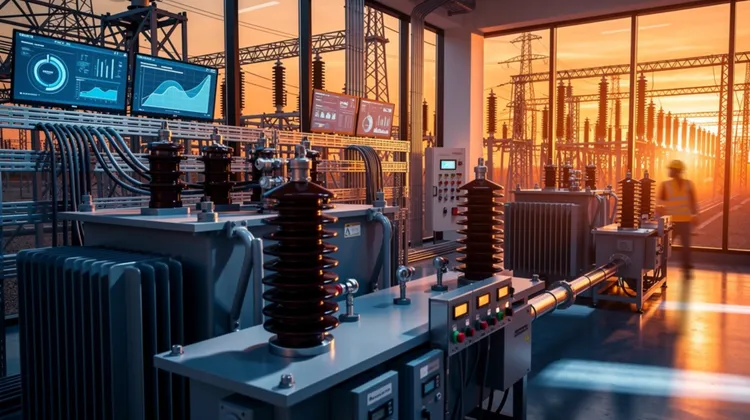
India’s digital revolution is not just a story of smartphones and high-speed internet; it is fundamentally a story of electrons. As the nation hurtles toward a future defined by data centers, cloud computing, and ubiquitous connectivity, the silent backbone supporting this transformation is the electrical grid. The ambition of a Digital India—spanning from remote villages streaming government services to metropolitan hubs processing terabytes of financial transactions—rests on a single, non-negotiable pillar: reliable, uninterrupted power. Without a robust and evolving grid, the digital dream risks becoming a digital mirage.
The scale of the challenge is immense. India’s data consumption per capita has exploded, driven by affordable data plans and the proliferation of connected devices. This surge places unprecedented stress on an infrastructure that was historically designed for a different era. The grid that once powered factories and homes is now being asked to power a hyper-connected economy that operates 24/7, with zero tolerance for downtime. A single voltage fluctuation in a data center can cascade into millions of rupees in losses and erode user trust, making power reliability the single most critical metric for the nation’s digital ambitions.
The Data Center Power Hunger
At the heart of this transformation lies the data center. These facilities are the physical engines of the digital economy, and they are voracious consumers of electricity. A typical hyperscale data center can consume as much power as a small town, and the demand is only intensifying with the rise of artificial intelligence and machine learning workloads, which require significantly more computational power and cooling.
For India, the growth trajectory is staggering. The country is rapidly becoming a global hub for data hosting, driven by data localization laws and a growing domestic user base. However, this growth is directly tied to grid capacity. Data centers cannot rely on a grid that experiences frequent outages or voltage sags. They require a stable, high-quality power supply that can be guaranteed around the clock. This has forced a critical evolution: data center operators are no longer just passive grid consumers; they are becoming active participants in the energy ecosystem, often investing in their own captive power generation and energy storage to ensure absolute uptime.
Grid Modernization: The New Mandate
To keep pace with this demand, the Indian grid is undergoing a massive modernization push. The traditional model of centralized power generation and one-way distribution is being replaced by a more dynamic, decentralized, and intelligent system. The focus is on building a grid that is not just bigger, but smarter and more resilient.
Key elements of this modernization include:
- Advanced Metering Infrastructure (AMI): Smart meters are being deployed across the country, enabling real-time monitoring of consumption and grid health. This data is crucial for predictive maintenance and for managing peak demand, preventing blackouts before they occur.
- High-Voltage Direct Current (HVDC) Lines: These are being used to transmit large volumes of power over long distances with minimal losses, crucial for connecting renewable energy-rich regions to major consumption centers.
- Phasor Measurement Units (PMUs): These provide high-speed, time-synchronized data on grid conditions, allowing operators to detect and respond to disturbances in milliseconds, significantly enhancing grid stability.
This is not merely an upgrade; it is a fundamental re-engineering of the grid’s architecture. The goal is to create a self-healing network that can automatically reroute power around faults, minimizing the impact of any single point of failure. This is the foundation upon which Digital India’s reliability is built.
The Renewable Energy Imperative
India’s grid evolution is also intrinsically linked to its renewable energy targets. The nation has committed to a massive expansion of solar and wind power. While commendable from an environmental standpoint, this introduces a new layer of complexity for grid operators. Solar and wind are inherently variable; the sun does not always shine, and the wind does not always blow. This intermittency creates grid stability challenges that were absent with traditional thermal power plants.
The solution lies in a combination of energy storage and flexible grid management. Battery energy storage systems (BESS) are becoming increasingly critical, acting as a buffer that absorbs excess energy during peak generation and discharges it when demand spikes. This not only smooths out the variability of renewables but also provides essential grid services like frequency regulation. For a data-driven economy that requires a constant, predictable power supply, the integration of storage is not optional—it is essential.
Uptime Monitoring: The New Currency of Reliability
As the grid becomes more complex, the tools to manage it must evolve in parallel. This is where advanced uptime monitoring and reliability analytics come into play. The days of reactive maintenance—waiting for a piece of equipment to fail before fixing it—are over. The new paradigm is predictive and prescriptive.
Modern monitoring systems use a combination of sensors, IoT devices, and artificial intelligence to continuously assess the health of grid assets, from transformers to transmission lines. This allows operators to:
- Predict Failures: By analyzing vibration, temperature, and acoustic signatures, algorithms can identify a failing component weeks before it causes an outage.
- Prioritize Maintenance: Limited maintenance crews can be deployed to the most critical assets first, optimizing resource allocation and minimizing downtime.
- Enhance Safety: Remote monitoring reduces the need for manual inspections in hazardous environments, protecting workers.
This data-driven approach to reliability is transforming the grid from a passive network into an intelligent organism that can self-diagnose and self-correct. It is the difference between a system that reacts to problems and one that prevents them from happening in the first place.
The Road Ahead: A Call for Strategic Investment
The journey toward a fully reliable, digital-ready grid is far from complete. It requires sustained, strategic investment in transmission infrastructure, distribution networks, and digital technologies. It also requires a policy framework that encourages innovation and private participation, while ensuring that the benefits of modernization are equitably distributed across the nation.
The future of Digital India is not just about building more data centers; it is about building the energy backbone that makes them viable. It is about creating a grid that is not a bottleneck to progress, but a catalyst for it. The challenge is immense, but so is the opportunity. By prioritizing power reliability, grid modernization, and intelligent energy management, India can ensure that its digital transformation is not just a fleeting moment, but a lasting legacy. The electrons that power the nation’s data centers are the same ones that will power its ascent on the global stage.