
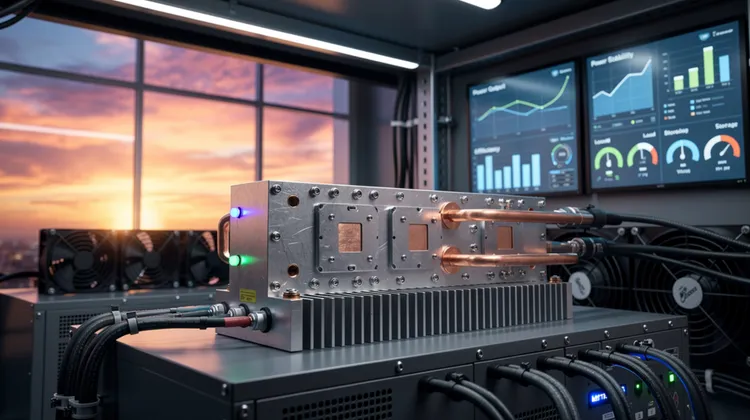
The global push for energy efficiency is forcing a fundamental shift in how power conversion systems are designed. For decades, silicon has been the workhorse of power electronics, but its physical limits are now a bottleneck. Enter silicon carbide (SiC) and gallium nitride (GaN)—wide bandgap semiconductors that are rewriting the rules of power density, thermal management, and system size.
These materials are not incremental improvements. They represent a step-change in performance, enabling switching frequencies ten to a hundred times higher than silicon while slashing conduction and switching losses. For engineers maintaining critical infrastructure—from data centers to industrial motor drives—this means smaller, cooler, and more reliable power modules that directly reduce total cost of ownership.
Why Silicon Hits Its Limits
Silicon power devices, such as IGBTs and MOSFETs, have been refined over five decades. They are cheap, reliable, and well understood. But as applications demand higher voltages, faster switching, and higher operating temperatures, silicon’s intrinsic properties become constraints. Its relatively narrow bandgap (1.1 eV) limits its ability to block high voltages without excessive resistance, and its switching speed is capped by charge storage effects.
In practice, this forces designers to use bulky transformers, large heat sinks, and complex cooling systems. A typical 100 kW silicon-based power converter might require a liquid cooling loop and occupy a full cabinet. The losses are not trivial—in high-power applications, silicon devices can waste 5–10% of the energy they process as heat. That heat must be removed, adding capital and operational expense.
SiC: The High-Voltage, High-Temperature Powerhouse
Silicon carbide (SiC) has a bandgap of 3.3 eV, roughly three times that of silicon. This allows SiC devices to block much higher voltages with thinner, lower-resistance drift regions. Commercially available SiC MOSFETs now handle 1200 V to 1700 V with specific on-resistance that is orders of magnitude lower than equivalent silicon devices.
The thermal advantages are equally dramatic. SiC can operate at junction temperatures exceeding 200°C, compared to silicon’s typical 150°C limit. This reduces cooling requirements significantly. In a solar inverter or an electric vehicle traction drive, switching to SiC can cut cooling system size by 40–60% while boosting efficiency to 99% or higher.
Real-World Impact
- Electric vehicle charging: SiC-based chargers achieve 98% efficiency, reducing charging time and heat generation.
- Data center power supplies: 80 Plus Titanium rated units now use SiC to hit 96% efficiency at full load.
- Industrial motor drives: SiC enables regenerative braking and higher switching frequencies, reducing motor harmonics and improving power quality.
GaN: Speed and Density for Medium-Power Applications
Gallium nitride (GaN) has a bandgap of 3.4 eV, similar to SiC, but its electron mobility is significantly higher. This makes GaN ideal for high-frequency switching in the 100 kHz to 10 MHz range—far beyond what silicon or even SiC can achieve.
GaN devices are typically lateral structures, which allow for very low gate charge and fast switching transitions. The result is power converters that are dramatically smaller. A 300 W GaN-based AC-DC adapter can be half the size of a silicon equivalent, with lower electromagnetic interference (EMI) due to faster switching and reduced ringing.
Where GaN Excels
- USB-C chargers and laptop adapters: GaN has already revolutionized consumer power supplies, shrinking 100 W chargers to pocket size.
- 5G base stations: GaN power amplifiers deliver higher efficiency and bandwidth in a smaller footprint.
- LiDAR systems: GaN’s fast switching enables high-frequency pulsed lasers for autonomous vehicle sensors.
- DC-DC converters in telecom: 48 V to 12 V converters using GaN achieve 97% efficiency at 1 MHz.
Reliability and System-Level Benefits
For maintenance and operations teams, the reliability story is compelling. Wide bandgap devices are inherently more robust against cosmic radiation-induced single-event burnout, a failure mode that plagues silicon devices at high altitude. They also exhibit lower thermal impedance, meaning they run cooler under load.
However, adoption requires careful design. Gate drive circuits must be optimized for fast switching transients, and layout parasitics become critical. Thermal cycling performance is generally excellent, but package selection matters—many SiC and GaN devices are now available in industry-standard TO-247 or surface-mount packages to ease integration.
Key Maintenance Considerations
- Reduced cooling system complexity: Fewer fans, pumps, and heat sinks mean fewer failure points.
- Higher power density: More kilowatts per cubic foot, freeing rack space in data centers and electrical rooms.
- Longer operational life: SiC and GaN devices have demonstrated mean time between failures (MTBF) exceeding 1 million hours in accelerated tests.
The Transition Is Underway
The economics are shifting. SiC wafers are now available in 150 mm and 200 mm diameters, driving cost down. GaN-on-Si substrates leverage existing silicon fabrication lines, further reducing price premiums. Industry analysts forecast the wide bandgap semiconductor market will exceed $10 billion by 2030, with SiC capturing the high-voltage segment and GaN dominating medium-power, high-frequency applications.
Major infrastructure sectors are already adopting these technologies. Utility-scale solar farms are specifying SiC inverters for their higher efficiency and smaller footprint. Data center operators are retrofitting power distribution units with GaN-based converters to reduce cooling loads. Hospital backup power systems are using SiC UPS modules for faster response and lower harmonic distortion.
What This Means for Uptime
For professionals responsible for uptime in critical infrastructure, the message is clear: wide bandgap semiconductors are not a future technology—they are here, and they are delivering measurable gains in efficiency, density, and reliability. Retrofitting existing systems may not always be practical, but specifying SiC or GaN for new installations or major upgrades is a proven path to lower energy costs and higher system availability.
The transition from silicon to SiC and GaN is not just about better components. It is about rethinking the entire power conversion architecture—from cooling to control to packaging. Early adopters are already seeing the payoff in reduced downtime, lower operating expenses, and longer equipment life. For those tasked with keeping the lights on, the message is simple: the future of power efficiency is wide bandgap, and it is already here.