
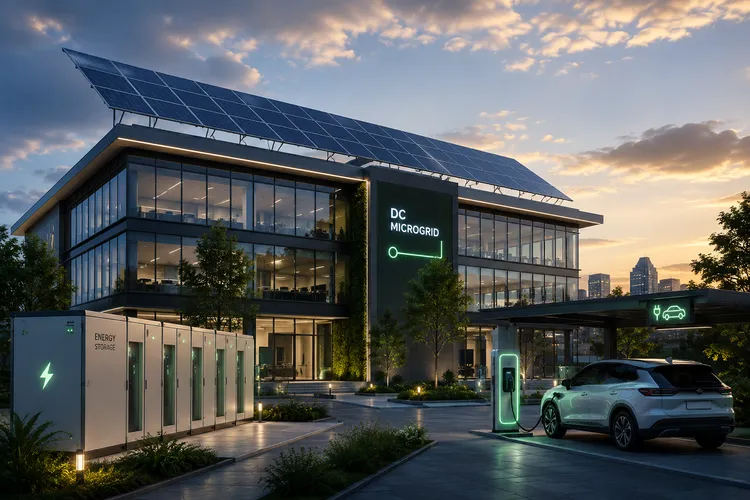
Imagine walking through a modern, high-tech office building. The lights are perfectly dimmed to reduce glare, the server rooms are humming with precision, and every sensor is communicating via the latest IoT protocols. On the surface, everything looks seamless. But underneath the floorboards and behind the walls, a silent, invisible battle against physics is being fought every single second.
That battle is the struggle against energy loss.
For over a century, our buildings have been designed around Alternating Current (AC). It was a brilliant solution for the industrial age, allowing electricity to be transmitted over long distances with relative ease. However, we have entered a new era. The devices we use most—LED lighting, computers, smartphones, electric vehicles, and battery storage systems—are inherently Direct Current (DC) devices.
When we power these DC devices using an AC grid, we are forced to perform a repetitive, inefficient dance: converting DC (from solar panels) to AC (for the building), only to immediately convert it back to DC (via a power brick or internal regulator) to run the actual device. Each conversion stage acts as a "tax," leaking energy in the form of wasted heat. This is why the shift toward DC microgrids is not just a trend; it is an architectural and energetic necessity for the 21st century.
The Efficiency Gap: The Hidden "Conversion Tax"
In a traditional AC-based building, the journey of an electron is unnecessarily circuitous. If a building relies on solar PV panels, the energy produced is DC. To use it in a standard building, it must pass through an inverter to become AC. When that AC power reaches a laptop charger or an LED driver, it must pass through a rectifier to become DC again.
Industry studies suggest that these multiple conversion stages can result in energy losses ranging from 5% to as much as 15% of the total power consumed. In a large-scale commercial building or a data center, a 10% efficiency loss isn't just a minor inconvenience—it translates to thousands of dollars in wasted electricity and a significantly higher carbon footprint.
By implementing a DC microgrid, we essentially eliminate this "conversion tax." By creating a unified DC bus, the energy stays in its native state from the moment it is harvested by a solar panel or released from a battery until the moment it reaches the end device.
What is a DC Microgrid?
A DC microgrid is a localized energy system that operates on direct current, capable of managing its own generation, storage, and consumption. Unlike a traditional building that simply "receives" power from a utility, a DC microgrid "manages" power.
The Unified DC Bus Architecture
The heart of this system is the Unified DC Bus. Think of this as a high-speed electrical highway. Instead of having separate, isolated systems for solar, batteries, and appliances, everything is connected to a common voltage level.
- Generation: Solar PV panels feed DC power directly into the bus.
- Storage: Battery Energy Storage Systems (BESS) act as a buffer, soaking up excess DC power during the day and releasing it during peak demand or at night.
- Consumption: DC-native appliances pull power directly from the bus without needing bulky, heat-generating adapters.
This streamlined architecture simplifies the electrical distribution network, reduces the number of components required, and significantly lowers the complexity of the system.
The Synergy of Solar, Storage, and DC Loads
The most compelling argument for DC microgrids lies in the perfect synergy between the three pillars of modern renewable energy: solar, storage, and load.
1. Seamless Solar Integration
Solar photovoltaic (PV) cells are naturally DC-producing devices. In a DC-centric building, the interface between the solar array and the building’s electrical system is direct. This minimizes the hardware footprint and maximizes the "yield-to-use" ratio of every photon captured.
2. Optimized Battery Management
Batteries are also DC devices. In an AC-centric world, if you want to store solar energy, you have to convert it to AC to charge the battery, and then convert it back to DC to use it. In a DC microgrid, the battery sits right on the bus. This allows for much more granular control over charging cycles and significantly improves the round-trip efficiency of the storage system.
3. The Rise of DC-Native Appliances
We are witnessing a massive shift in how hardware is manufactured.
-
LED Lighting: Modern LED drivers are essentially small DC-to-DC converters.
-
IT and Data Centers: Servers and networking equipment have always been DC-powered internally.
-
IoT and Smart Sensors: The backbone of modern building automation is low-voltage DC.
-
Electric Vehicles (EVs): As EV charging stations become standard in building parking structures, the ability to provide direct DC fast-charging from a building's solar/battery system becomes a massive advantage.
Challenges in the Transition
If the benefits are so clear, why hasn't every building switched to DC? The transition faces two primary hurdles: standardization and initial capital expenditure (CAPEX).
Most of our current building codes, electrical standards, and consumer products are built around the 120V/230V AC paradigm. Moving to a DC-native architecture requires a new set of safety standards and specialized circuit breakers and distribution hardware. Furthermore, while the operational expenditure (OPEX) is lower due to energy savings, the initial cost of implementing a DC microgrid can be higher than traditional AC wiring.
However, as the cost of solar panels and lithium-ion batteries continues to plummet, and as the demand for "Net Zero" buildings intensifies, these barriers are rapidly eroding.
The Path to Net-Zero Buildings
As global mandates push for carbon neutrality, architects and engineers are no longer looking for incremental improvements; they are looking for systemic transformations. DC microgrids represent a fundamental shift from "consuming energy" to "managing energy."
By reducing waste, simplifying infrastructure, and maximizing the utility of renewable sources, DC microgrids provide a technical roadmap to achieving truly sustainable, self-sufficient structures. The buildings of the future will not just be passive shells that consume power; they will be active, efficient, and intelligent energy ecosystems.