
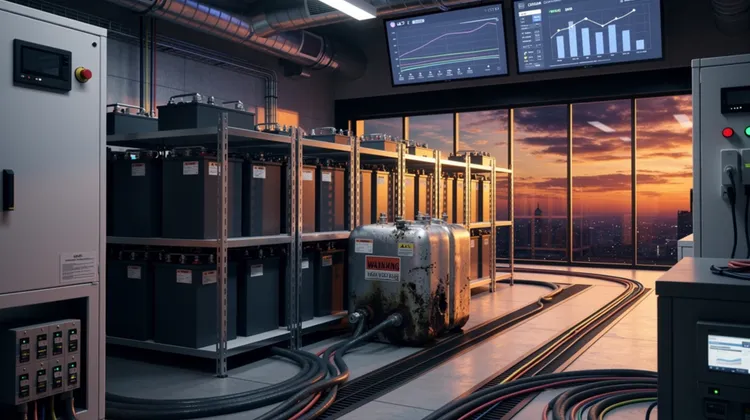
The hum of a data center is the sound of modern civilization. It’s the quiet whir of cooling fans, the soft glow of server lights, and the reassuring thrum of uninterruptible power supplies (UPS) standing guard. But when that hum stops—when the battery backup fails—the silence is deafening. And it’s happening more often than most realize.
Battery backup systems are the unsung heroes of critical infrastructure. They bridge the gap between a utility power failure and the start of a generator, or they provide clean power during sags and surges. Yet, despite their importance, they remain the hidden weak link in energy resilience. Real-world incidents reveal that battery failures are not rare anomalies; they are predictable outcomes of neglect, poor design, and a lack of rigorous testing.
The Anatomy of a Battery Backup Failure
Battery banks in UPS systems are typically composed of valve-regulated lead-acid (VRLA) or lithium-ion cells. These batteries degrade over time, and their failure modes are well-documented. Yet, time and again, facilities are caught off guard.
One of the most notorious incidents occurred at a major financial data center in the United Kingdom in 2018. The facility lost primary power due to a grid fault. The UPS systems kicked in, but within minutes, multiple battery strings failed. The result: a complete blackout that took down trading platforms for hours. The root cause was thermal runaway in aging VRLA batteries, accelerated by an ambient temperature rise of just a few degrees.
Another example comes from a hospital in the United States. During a severe storm, the utility power failed. The backup generator started, but the UPS battery bank could not hold the load during the transfer. The result was a 30-second power gap that caused critical medical equipment to reboot, including a ventilator supporting a patient in intensive care. The investigation revealed that the batteries had not been load-tested in over two years.
Why Do Backup Systems Fail?
Battery backup failures are rarely due to a single cause. Instead, they result from a combination of factors:
- Age and degradation: VRLA batteries typically last 3 to 5 years, but many facilities push them to 7 or 8 years to save costs. Capacity loss is gradual and invisible without testing.
- Thermal runaway: High ambient temperatures accelerate chemical reactions inside batteries, leading to swelling, leakage, and catastrophic failure.
- Poor maintenance: Batteries are often out of sight, out of mind. Quarterly inspections and annual load tests are skipped or performed inadequately.
- Incorrect sizing: UPS systems are sometimes designed with insufficient battery runtime for the actual load, leaving no margin for error.
- Manufacturing defects: Even new batteries can fail if they have internal defects or are damaged during shipping.
The Cost of Failure
The financial impact of a battery backup failure can be staggering. For data centers, the average cost of unplanned downtime is over $7,900 per minute, according to industry studies. For hospitals, the cost is measured in lives. In industrial facilities, a power interruption can lead to equipment damage, lost production, and safety hazards.
A 2022 study by the Uptime Institute found that nearly one-third of all data center outages are caused by UPS or battery failures. That makes battery backup the single most common cause of downtime in critical facilities. Yet, many organizations treat battery maintenance as a low-priority task.
Lessons from the Front Lines
There are several high-profile incidents that offer clear lessons:
- The Facebook Outage (2021): A configuration error triggered a cascading failure in the company’s data centers, but the backup systems were unable to prevent a six-hour global outage. While the root cause was software-related, the incident highlighted that even massive redundancy can be undermined by a single point of failure.
- The OVHcloud Fire (2021): A fire at a French data center destroyed four server rooms and caused widespread outages. The fire started in a UPS battery bank, likely due to thermal runaway in lithium-ion batteries. This incident underscored the fire risks associated with newer battery technologies.
- The Amazon Web Services Outage (2017): A human error during routine maintenance caused a power failure at an AWS data center. The backup generators started, but the UPS batteries failed to hold the load during the transfer. The outage affected thousands of websites and services.
Preventing Battery Backup Disasters
Prevention starts with a shift in mindset. Battery backup systems must be treated as critical components, not afterthoughts. Here are actionable strategies:
Implement a rigorous testing regimen
Load testing should be conducted at least annually, and preferably quarterly for older batteries. Use battery monitoring systems that track voltage, temperature, and internal resistance in real time. Early detection of anomalies can prevent failures.
Replace batteries on a scheduled basis
Don’t wait for failure. Replace VRLA batteries every 3 to 5 years, even if they appear to be working. Lithium-ion batteries have longer lifespans (10 to 15 years) but require careful thermal management.
Control the environment
Battery rooms should be maintained at a consistent temperature between 68°F and 77°F (20°C to 25°C). High temperatures accelerate degradation. Install HVAC backup and ensure proper ventilation.
Design for redundancy
Use multiple smaller battery strings instead of one large bank. This allows for maintenance and testing without taking the entire system offline. Consider N+1 or 2N redundancy for critical loads.
Invest in monitoring and analytics
Modern battery monitoring systems provide continuous data on health and performance. Advanced analytics can predict failures weeks in advance, giving time for corrective action.
Train personnel Operators and maintenance staff should be trained to recognize signs of battery degradation, such as bulging cases, corrosion, or unusual odors. They should also understand the importance of proper torque on connections and the dangers of thermal runaway.
The Future of Backup Power
Battery technology is evolving rapidly. Lithium-ion batteries are becoming more common in UPS systems due to their higher energy density and longer lifespan. However, they also introduce new risks, including fire hazards and the need for sophisticated battery management systems.
Flow batteries and solid-state batteries are emerging as alternatives that offer even greater safety and longevity. But for now, the vast majority of critical infrastructure still relies on VRLA technology. The key is to manage that technology with the discipline it demands.
#