
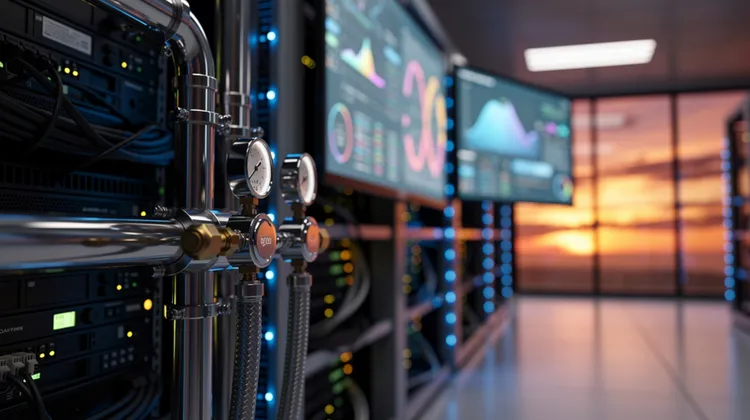
Every internet search, every streamed video, every financial transaction you make depends on a silent, invisible battle being fought inside thousands of data centers worldwide. That battle isn't against hackers or software bugs—it's against heat. A modern data center rack can consume over 40 kilowatts of power, and nearly all of that energy turns into heat. When cooling systems fail, that heat builds up with terrifying speed, creating a cascade of failures that can take down critical cloud services in minutes.
The challenge has grown exponentially in recent years. Server densities have tripled since 2015, with some hyperscale deployments now exceeding 50 kW per rack. Traditional raised-floor cooling systems, which push cold air through perforated tiles, simply cannot keep up. The result is a growing number of thermal events that threaten uptime across the industry.
The Mechanics of a Thermal Cascade
Understanding how cooling failures escalate is essential for any infrastructure manager. A thermal cascade begins when one cooling unit fails—perhaps a compressor trips or a chilled water valve sticks. Immediately, the affected zone begins to warm. Server fans, designed to maintain internal temperatures, spin faster to compensate. This increased fan speed draws more power, which generates more heat.
As temperatures rise further, neighboring cooling units must work harder to maintain their own zones. Their compressors cycle more frequently, and their fans ramp up. This increased workload can cause secondary failures, especially in systems already operating near capacity. Within 15 to 20 minutes of an initial cooling failure, a data center can experience a full thermal runaway event.
The physics are unforgiving. For every 10°C rise in inlet air temperature, server reliability drops by approximately 50%. At 35°C inlet temperatures, some servers begin automatic shutdown sequences. At 40°C, hard drive failures become almost certain. The Uptime Institute reports that 28% of all data center outages are now directly caused by cooling system failures, making thermal management the single largest cause of downtime.
Liquid Cooling: The New Standard
The most significant innovation in data center cooling over the past five years has been the widespread adoption of liquid cooling technologies. Direct-to-chip liquid cooling circulates coolant through cold plates mounted directly on server processors. This approach can handle heat densities exceeding 100 kW per rack, far beyond what air cooling can manage.
Immersion cooling takes this concept further by submerging entire servers in dielectric fluid. The fluid absorbs heat directly from every component, eliminating the need for server fans entirely. Early adopters report power savings of 20-30% on cooling alone, with server failure rates dropping by as much as 40%.
However, liquid cooling introduces its own failure modes. Leaks can short-circuit electrical systems. Pump failures can cause localized hot spots that develop faster than in air-cooled environments. The industry has responded with double-walled piping, leak detection sensors at every connection point, and redundant pump configurations that automatically switch over within milliseconds of a failure signal.
AI-Driven Thermal Management
Artificial intelligence has transformed how data centers manage cooling loads. Modern AI systems monitor thousands of temperature sensors across the facility, along with power consumption data from every server, weather forecasts, and even time-of-day usage patterns. These systems can predict thermal events 15 to 30 minutes before they occur, giving operators time to adjust cooling capacity dynamically.
Google's DeepMind AI famously reduced their data center cooling costs by 40% while improving temperature stability. The system learned to anticipate load shifts and adjust cooling proactively rather than reactively. Today, similar systems are becoming standard equipment in new hyperscale facilities.
The key advantage of AI-driven management is its ability to handle complex interdependencies. A traditional control system might see a temperature spike in one zone and respond by opening that zone's cooling valve wider. An AI system recognizes that the spike is caused by a shift in compute load from another zone, and adjusts cooling across multiple zones simultaneously to prevent a cascade.
Containment Strategies That Work
Physical containment remains one of the most cost-effective ways to prevent thermal cascades. Hot aisle containment systems create a physical barrier between the hot exhaust air from servers and the cold intake air. This prevents recirculation, where hot air wraps around to the front of racks and raises inlet temperatures.
Cold aisle containment achieves the same effect by enclosing the cold supply air path. Both approaches can reduce fan energy consumption by 25-35% and improve temperature uniformity across the data center floor.
The most effective containment designs include:
- Pressure-controlled containment doors that open only when differential pressure exceeds safe limits
- Blank-off panels that prevent air bypass in unused rack spaces
- Overhead cable trays that don't obstruct airflow patterns
- Perforated tile placement optimized by computational fluid dynamics modeling
Redundancy and Zoning
No cooling system is immune to failure, which is why redundancy is critical. The industry standard N+1 configuration provides one additional cooling unit beyond what's needed for peak load. However, many hyperscale operators now deploy 2N or even 2N+1 configurations, especially for critical zones housing financial trading systems or emergency services infrastructure.
Zoning is equally important. Modern data centers divide their floor into thermal zones, each with independent cooling capacity. If one zone's cooling fails, the zone can be isolated and its servers gracefully migrated to other zones before temperatures become critical. This approach requires careful load planning and automated workload migration tools, but it has proven effective at preventing full facility outages.
The Future of Data Center Cooling
Looking ahead, several emerging technologies promise to further reduce thermal risks. Two-phase liquid cooling uses the latent heat of vaporization to absorb enormous amounts of heat from server components. In these systems, coolant boils at a precisely controlled temperature, carrying heat away as vapor that is then condensed and recirculated.
Waste heat recovery is also gaining traction. Instead of dumping heat into the atmosphere, some facilities now capture it for district heating systems, greenhouse warming, or industrial processes. This not only reduces environmental impact but can provide a secondary revenue stream that offsets cooling costs.
The most ambitious projects are exploring underwater and space-based data centers, where ambient temperatures are naturally low and stable. Microsoft's underwater data center experiment demonstrated lower failure rates than land-based equivalents, largely due to the consistent cooling environment.
For infrastructure managers today, the lesson is clear: cooling is no longer a secondary consideration. It is the primary determinant of data center reliability. Investing in modern cooling technologies, AI-driven management, and robust containment strategies is not optional—it is essential for maintaining uptime in an increasingly heat-dense computing environment.