
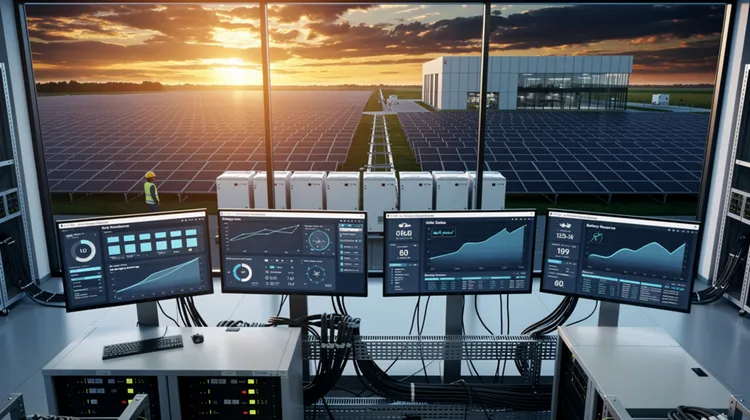
The cloud has a carbon problem. For over a decade, the world’s largest technology companies have signed power purchase agreements (PPAs) for gigawatts of solar and wind capacity, touting their progress toward "100% renewable energy." Yet, the physical reality of a solar farm or wind turbine is fundamentally different from a coal or gas plant. The sun sets, and the wind stops blowing. For hyperscale data centers and the critical infrastructure they host, this intermittency is not a minor inconvenience—it is the central engineering challenge of the green transition.
The question is no longer if renewables will power the cloud, but how they can do so without sacrificing the 99.999% uptime that the financial, healthcare, and defense sectors depend on. The answer lies not in a single silver bullet, but in a complex re-engineering of how we generate, store, and consume electricity.
The Baseload Delusion
The traditional model of grid reliability relies on baseload power—large, constant generators running 24/7. Renewables are variable energy resources (VERs). A single utility-scale solar plant typically operates at a capacity factor of 20-25%, meaning it produces only a quarter of its potential output over a year. Wind fares slightly better, often hitting 35-45% in prime locations.
This variability creates a stark reality for mission-critical operators. A data center cannot "pause" its operations when a cloud front passes over a solar farm. The servers require a constant 60 Hz frequency, and a drop in voltage or a sudden spike can cause cascading failures that trigger hardware lockdowns and data corruption.
This is why the industry is moving away from the vague metric of "renewable energy credits" (RECs) toward a more rigorous standard: 24/7 carbon-free energy (CFE). This approach demands that every kilowatt-hour consumed at a specific facility is matched by a carbon-free source at the same hour. It is a much harder target, but it is the only one that ensures physical, not just accounting, reliability.
The Storage Imperative
If we cannot control the sun or the wind, we must control the output. The primary solution is energy storage, specifically battery energy storage systems (BESS). Lithium-ion battery farms are no longer a pilot project; they are becoming standard co-located assets at new renewable installations.
However, the scale required is staggering. A single 100 MW data center running at full tilt requires 2,400 MWh of energy per day. To survive a night with no wind and no sun, that facility would need a battery bank with a capacity several times that amount. The cost and physical footprint of such a system are prohibitive for most operators.
Instead, the industry is adopting a hybrid approach:
- Short-duration storage (4-6 hours): Lithium-ion batteries handle frequency regulation and peak shaving, smoothing out minute-to-minute fluctuations in renewable output.
- Long-duration storage (10-100+ hours): Emerging technologies like iron-air batteries, flow batteries, and compressed air energy storage (CAES) are being tested to cover multi-day "dunkelflaute" events—periods of low wind and low sun in winter.
These systems act as a buffer, effectively converting intermittent renewables into a dispatchable power source that can be called upon when needed.
The Grid as a Battery
While on-site storage is critical, it is not the whole solution. The most efficient and cost-effective way to handle renewable intermittency at scale is to use the grid itself as a massive balancing mechanism. This requires a fundamental upgrade to how the transmission network is managed.
The rise of the "smart grid" is enabling this shift. Advanced weather forecasting models, coupled with AI-driven grid management software, allow operators to predict renewable output with high accuracy 24 to 48 hours in advance. This foresight allows them to pre-position thermal backups (like gas peaker plants) and schedule energy storage to fill the gaps.
For mission-critical facilities, this means moving from a "passive consumer" to an "active participant" model. Data centers are increasingly being equipped with on-site diesel or natural gas generators, not as primary power, but as a "bridge" fuel for rare, multi-day outages. The goal is to reduce runtime on these generators to less than 5% of the year, while relying on renewables and storage for the other 95%.
The Nuclear Wildcard
To achieve true carbon-free, always-on power, many experts argue that we cannot rely on solar and wind alone. The physics of intermittency dictate that we need a clean baseload source. This is why there is a resurgence of interest in advanced nuclear power, specifically Small Modular Reactors (SMRs).
SMRs offer the promise of factory-built, scalable power plants that can be co-located with large data center campuses. A single 300 MW SMR could provide constant, carbon-free power to a hyperscale facility for years without refueling. Tech giants like Microsoft and Google have already signed agreements to explore this avenue.
This is not a rejection of solar and wind but a recognition of their limitations. In a hybrid portfolio, nuclear provides the steady foundation, while renewables and storage handle the variable load above that baseline. This combination could finally deliver on the promise of green power that is also "always on."
The Human Factor in Green Uptime
As we transition to a more complex energy mix, the role of the human operator becomes more critical, not less. A grid powered by renewables is more volatile and requires faster decision-making than a grid powered by steam turbines.
Control room operators at data centers and utility companies are now working with dashboards that display real-time solar irradiance, wind speed forecasts, and battery state-of-charge alongside traditional metrics like frequency and voltage. They must be trained to interpret these new data streams and execute load-shedding protocols or activate storage assets without hesitation.
This is where the concept of "uptime" expands beyond the facility walls. It now includes the reliability of the supply chain for battery cells, the stability of the transmission network, and the accuracy of weather models. A mission-critical operator today is as much an energy trader as they are an IT professional.
The Cost of Certainty
The transition to green, always-on power is not cheap. Building the storage capacity and grid interconnections required to firm up renewables adds significant capital expenditure. However, the long-term operational costs are falling. The Levelized Cost of Energy (LCOE) for solar and wind has dropped by over 80% in the last decade, and battery costs are following a similar trajectory.
For the C-suite, this creates a strategic balancing act. The cost of downtime remains astronomically high—estimated at up to $9,000 per minute for a large enterprise. Therefore, any energy strategy that introduces even a 0.01% risk of a brownout is a non-starter. The investment in storage and smart controls is not just an environmental gesture; it is an insurance policy against the catastrophic financial and reputational damage of an outage.
The future of mission-critical power is not a choice between green or reliable. It is a mandate to build a system that is both. This will require a mix of renewables, storage, smart grid software, and perhaps nuclear baseload, all managed by highly skilled engineers. The cloud is going green, but it is doing so with its eyes wide open, engineering for the worst-case scenario while optimizing for a carbon-free world.