
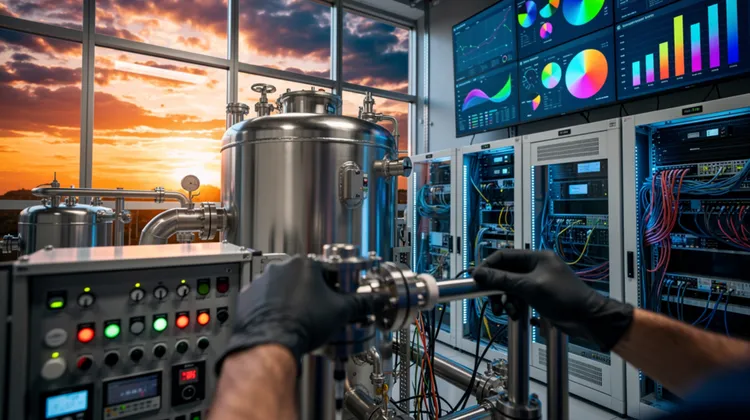
The digital economy runs on an invisible promise: that data is always there when you need it. A single minute of downtime at a major cloud provider can cost hundreds of thousands of dollars, and for hospitals, financial markets, or emergency services, the stakes are far higher. Yet the infrastructure that powers this always-on world is increasingly fragile. Grid congestion, extreme weather events, and the sheer appetite of AI workloads have pushed data center operators to rethink their most basic assumption: that reliable power will simply be there when they plug in.
Enter the microreactor. These compact nuclear fission units, typically generating between 1 and 20 megawatts of electricity, are being positioned as the ultimate answer to energy independence and constant uptime. Unlike traditional nuclear plants that require massive cooling systems and sprawling safety zones, microreactors are designed to be factory-built, truck-transportable, and capable of operating for years without refueling. For data centers that need round-the-clock power with zero carbon emissions, they offer a tantalizing proposition.
The shift is already underway. In 2024, major technology firms announced partnerships with nuclear developers to explore on-site microreactor deployment. The U.S. Department of Energy has streamlined licensing pathways for these advanced reactors, and several states have passed legislation to encourage their use in critical facilities. The question is no longer whether microreactors will power data centers, but how quickly they can be deployed safely and economically.
Why Data Centers Are Turning to Microreactors
The modern data center is a power-hungry beast. A single hyperscale facility can consume as much electricity as a small city, and AI training clusters are pushing that demand to unprecedented levels. According to the International Energy Agency, data centers consumed roughly 460 terawatt-hours of electricity in 2022, a figure that could double by 2026. This growth is colliding with an aging grid that was never designed for such concentrated loads.
Microreactors address three fundamental problems simultaneously. First, they provide firm, dispatchable power that is not dependent on weather or grid conditions. Unlike solar and wind, which require massive battery storage to ensure uptime, a microreactor runs continuously at full output. Second, they offer true energy independence. A data center with its own reactor is insulated from grid failures, price spikes, and geopolitical disruptions to fuel supplies. Third, they deliver this power with zero carbon emissions, helping operators meet aggressive sustainability targets.
The economic case is becoming clearer as well. While the upfront capital cost of a microreactor is substantial, the long-term operational savings can be significant. Nuclear fuel is incredibly energy-dense; a single fuel load can power a facility for years, eliminating the volatility of natural gas prices and the logistics of diesel deliveries. For a large data center campus, the levelized cost of electricity from a microreactor can be competitive with grid power, especially when factoring in the cost of downtime avoidance.
The Technology Behind Microreactors
Microreactors are not simply scaled-down versions of traditional nuclear plants. They represent a fundamentally different approach to fission. Most designs use high-assay low-enriched uranium (HALEU), which contains a higher concentration of the fissile isotope U-235 than conventional reactor fuel. This allows for a more compact core and longer operational life between refueling cycles.
The reactors are typically designed with passive safety features that require no operator intervention or external power to shut down safely. Advanced cooling systems, often using liquid metal or high-temperature gas instead of water, allow the reactors to operate at higher temperatures and efficiencies. This makes them ideal for applications beyond electricity generation, including industrial heat, hydrogen production, and desalination.
One of the most compelling aspects of microreactor technology is its transportability. Units are designed to be built in a factory, shipped on a standard truck trailer, and installed on-site with minimal civil works. This significantly reduces construction timelines compared to traditional nuclear projects, which can take a decade or more. Some developers claim they can deploy a microreactor within 18 to 24 months of receiving a license.
Safety and Regulatory Considerations
The idea of placing a nuclear reactor on a data center campus raises understandable questions about safety. However, microreactor designs address these concerns through inherent physics rather than engineered safeguards. The small core size means that the total radioactive inventory is far lower than a conventional plant. Passive cooling systems mean that even in a complete loss of power, the reactor would cool itself without melting down.
Regulatory frameworks are evolving to accommodate these new designs. The U.S. Nuclear Regulatory Commission has established a streamlined licensing pathway for microreactors, and several other countries are following suit. The key challenge is demonstrating that the safety case holds across the entire lifecycle, from manufacturing through operation and eventual decommissioning.
Security is another consideration. Data centers are already high-security facilities, and adding a nuclear component requires additional layers of physical protection and personnel vetting. However, the small footprint of a microreactor makes it easier to secure than a sprawling traditional plant. The fuel is also less attractive for proliferation because HALEU is not directly usable in weapons.
The Role of Microreactors in Grid Resilience
Beyond individual data centers, microreactors could play a broader role in grid resilience. As extreme weather events become more frequent, the ability to island critical facilities from the grid becomes increasingly valuable. A data center with its own microreactor can continue operating even when surrounding areas are blacked out, providing essential services to hospitals, emergency response centers, and communication networks.
This distributed approach to nuclear power represents a philosophical shift from the centralized model that has dominated the industry for decades. Instead of building enormous plants far from population centers, microreactors can be deployed exactly where power is needed most. This reduces transmission losses and eliminates the need for massive new transmission lines, which are often the bottleneck in connecting new renewable energy sources.
The concept is not without its critics. Some experts argue that the regulatory burden and public perception challenges of nuclear power will make microreactor deployment slow and expensive. Others point to the waste management question, although microreactors produce far less waste per unit of energy than conventional reactors. The industry is working on advanced fuel cycles that could recycle spent fuel, further reducing the environmental footprint.
The Road Ahead
The convergence of data center growth, grid constraints, and climate commitments has created a unique moment for microreactor technology. The first commercial deployments are expected within the next few years, with several developer-operator pairings already announced. The success of these initial projects will be critical in demonstrating the technology's reliability and economic viability.
For data center operators, the decision to invest in microreactor technology is a bet on the future. It requires navigating complex regulatory landscapes, building new supply chains, and managing public perception. But for those who value uptime above all else, the promise of a self-contained, carbon-free, always-on power source is difficult to ignore.
The digital infrastructure that underpins modern life cannot afford to be at the mercy of an overtaxed grid. Microreactors offer a path to true energy independence, where the power that keeps our data flowing is as reliable as the data itself. As the technology matures and costs come down, the question will shift from whether microreactors will power data centers to how many will be deployed. The era of nuclear-powered uptime is approaching, and it promises to reshape the way we think about critical infrastructure resilience.