
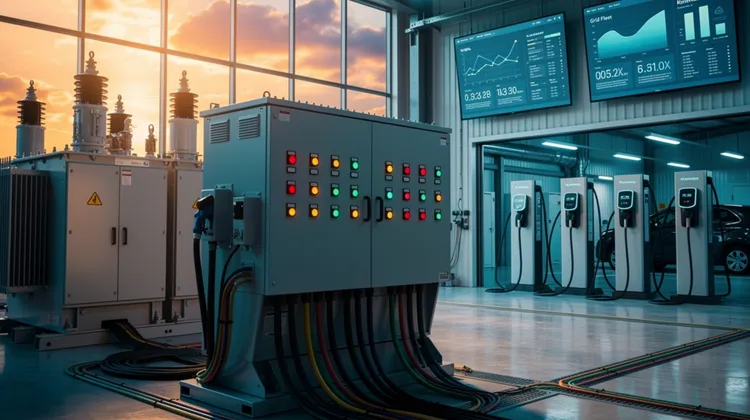
As industrial facilities accelerate their transition to electric vehicle (EV) fleets, the electrical infrastructure required to support large-scale charging stations presents a complex set of technical challenges. Unlike residential or small commercial charging, industrial EV fleet integration demands a deep understanding of power architecture, load management, and grid interaction. The stakes are high: a poorly planned installation can lead to costly downtime, equipment damage, or even grid penalties.
The fundamental issue is scale. A single heavy-duty EV charger for a delivery truck can draw 150 kW or more. Multiply that by a fleet of 50 or 100 vehicles, and the total power demand can rival a small manufacturing plant. This load is not static; it peaks during specific charging windows, often coinciding with other facility operations. Without careful planning, the existing electrical infrastructure—transformers, switchgear, and feeders—can become a bottleneck.
Understanding Load Profiles and Peak Demand
The first step in any integration project is a comprehensive load study. Industrial facilities typically have a base load from machinery, lighting, and HVAC. Adding EV charging introduces a new, variable load that can spike during shift changes or overnight charging schedules. The key is to analyze the facility’s existing load profile and determine the maximum additional demand the charging station will impose.
Most industrial utilities charge based on peak demand, often measured over 15-minute intervals. A sudden spike from multiple chargers starting simultaneously can dramatically increase these demand charges, sometimes doubling the monthly electric bill. To mitigate this, engineers must design charging schedules that stagger start times or use load management systems that prioritize charging based on vehicle departure times and battery state of charge.
Transformer and Switchgear Upgrades
Many industrial facilities were designed decades ago, with transformers sized for existing loads. Adding EV charging often requires upgrading the main service transformer. For example, a facility with a 1,000 kVA transformer handling current loads may need a 1,500 kVA or larger unit to accommodate 20 Level 3 chargers. This is not just a matter of capacity; the transformer must also handle the harmonic distortion generated by modern chargers.
Switchgear and panel boards must be evaluated for fault current ratings and ampacity. Older equipment may not support the continuous high current draw of multiple chargers. In some cases, installing a dedicated switchboard for the charging station, separate from the facility’s main distribution, can simplify upgrades and provide better isolation for maintenance.
Power Quality and Harmonic Distortion
EV chargers, particularly fast-charging units, use power electronics that can inject harmonic currents into the electrical system. High harmonic distortion can overheat transformers, cause nuisance tripping of breakers, and interfere with sensitive industrial equipment. IEEE 519 standards provide guidelines for acceptable harmonic levels, but compliance often requires installing active harmonic filters or choosing chargers with built-in power factor correction.
Power factor is another concern. Many chargers operate at a lagging power factor, especially when not at full load. Industrial facilities may face penalties if the overall power factor drops below a certain threshold. Capacitor banks or advanced charger designs that support reactive power compensation can help maintain a healthy power factor.
Grid Interconnection and Utility Coordination
Integrating large-scale charging into an industrial facility’s electrical system is not a standalone project. The utility must be involved from the start. The facility’s service entrance may need a new transformer from the utility’s side, or a dedicated feeder line. In many regions, utilities require a detailed interconnection study to assess the impact on the local grid.
Time-of-use rates and demand response programs can offer significant savings. By scheduling charging during off-peak hours, facilities can reduce electricity costs and potentially earn incentives. However, this requires advanced energy management systems that can communicate with both the chargers and the utility’s grid signals.
Energy Storage and On-Site Generation
To mitigate peak demand and provide backup power, many industrial facilities are pairing EV charging with battery energy storage systems. A 500 kWh battery bank can absorb power during low-demand periods and discharge during peak charging windows, flattening the load profile. This not only reduces demand charges but also provides resilience during grid outages.
On-site solar or wind generation can further offset the charging load, but the intermittent nature of renewables adds complexity. Microgrid controllers can orchestrate the interaction between generation, storage, and charging to optimize energy use and minimize grid reliance.
Charging Infrastructure Layout and Scalability
The physical layout of charging stations within an industrial facility requires careful thought. Chargers must be placed close to the vehicles’ parking or staging areas, but also near electrical rooms to minimize cable runs and voltage drop. Conduit and trenching for high-voltage cables must avoid underground utilities and comply with local codes.
Scalability is critical. A fleet may grow over time, so the infrastructure should be designed for future expansion. This means leaving spare conduits, installing switchgear with extra breaker positions, and sizing transformers to accommodate future loads. Modular charging systems that allow adding chargers incrementally are often more cost-effective than a single large installation.
Safety and Compliance
Industrial EV charging introduces new safety considerations. High-voltage DC cables, if damaged, can arc and cause fires. Proper grounding, arc-fault protection, and emergency disconnect switches are mandatory. Facilities must also comply with NFPA 70 (National Electrical Code) and local fire codes, which may require specific clearances around chargers and ventilation for battery storage areas.
Personnel training is often overlooked but essential. Maintenance electricians must understand the unique hazards of DC charging systems and how to safely isolate equipment. Lockout/tagout procedures must be updated to include charging station components.
Software and Monitoring
Modern EV charging infrastructure relies heavily on software for management and optimization. Charging management systems (CMS) can monitor energy consumption, track vehicle charging status, and generate reports for utility billing. Integration with the facility’s building management system (BMS) allows for coordinated load shedding and demand response.
Real-time monitoring of power quality parameters—voltage, current, harmonics, and power factor—is essential for early detection of issues. Alerts for abnormal conditions can prevent equipment damage and unplanned downtime.
Conclusion
Integrating large-scale EV charging into industrial power architectures is a multifaceted engineering challenge that requires a holistic approach. From load studies and transformer upgrades to power quality management and utility coordination, every aspect demands careful planning and execution. The facilities that succeed will not only reduce their carbon footprint but also gain operational efficiencies and cost savings. As EV adoption accelerates, those with robust, scalable charging infrastructure will be best positioned to thrive in an electrified future.