
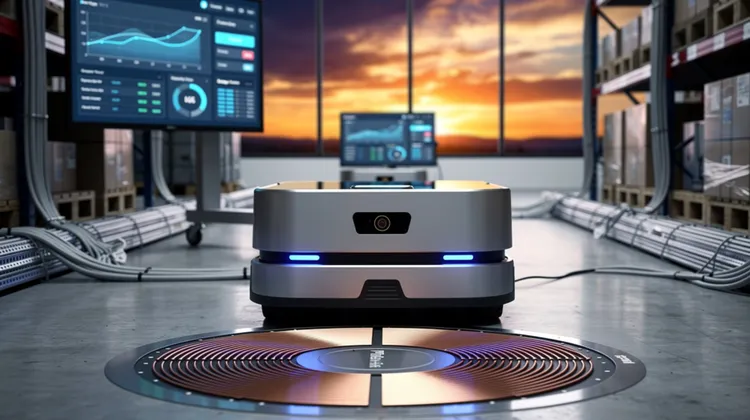
The promise of autonomous mobile robots (AMRs) in logistics has always been about uninterrupted flow. Yet, for years, the weakest link in that chain has been the charging process. Traditional plug-in or contact-based charging demands that robots cease operations, navigate to a specific docking station, and remain stationary for extended periods. This creates a bottleneck that undermines the very efficiency AMRs are meant to deliver. Enter wireless inductive charging—a solution that is quietly transforming how warehouses, distribution centers, and manufacturing facilities approach robot fleet management.
Inductive charging, at its core, is not a new technology. It has powered electric toothbrushes and smartphone pads for years. However, adapting it for high-power, industrial-grade AMR applications requires significant engineering. The principle remains the same: an alternating current passes through a primary coil in the charging pad, generating a magnetic field. A secondary coil in the robot converts that field back into electrical current to charge the battery. The key difference in logistics is the power level—typically 1 kW to 3 kW for AMRs—and the need for precise alignment, even with positional tolerances of several centimeters.
Why Docking Is a Bottleneck
Traditional charging methods force AMRs to interrupt their workflow. A robot must locate a charging station, approach it with millimeter precision, and physically connect. This process can take 30 seconds to several minutes, depending on alignment accuracy. Multiply that by dozens of robots in a fleet, and the cumulative downtime becomes significant. More critically, it disrupts the flow of goods. A robot that needs to charge mid-shift might have to travel 100 meters or more to the nearest station, wasting energy and time.
Wireless inductive charging eliminates this. Charging pads can be embedded directly into the floor at strategic points throughout the facility—along travel paths, near workstations, or even under storage racks. Robots can recharge during brief pauses, such as when waiting for a pallet to be loaded or when passing through a designated zone. This concept, often called "opportunity charging," allows robots to top up their batteries in short bursts throughout the day, rather than requiring a single long charging session.
The Technical Implementation
Implementing wireless inductive charging in a logistics environment requires several components working in harmony. The charging pad itself is a ruggedized unit, typically encased in industrial-grade epoxy or polyurethane to withstand forklift traffic, spills, and debris. These pads are flush-mounted to the floor, creating no tripping hazard or obstruction. The robot carries a receiver coil, usually mounted on its underside, along with power management electronics that communicate with the pad.
Communication is critical. The robot and pad use a low-power wireless protocol, often based on the Qi standard or a proprietary industrial variant, to negotiate power levels, alignment status, and fault conditions. When a robot positions itself over a pad, the system detects the presence of the receiver and begins power transfer. Advanced systems can adjust power output in real-time based on the robot's battery state of charge and temperature.
One of the most significant technical challenges is foreign object detection. Metal objects, such as tools or debris, can become heated by the magnetic field, posing a safety risk. Modern inductive charging pads incorporate sensors that detect foreign objects and immediately halt power transfer. Similarly, living object detection ensures that no personnel or animals are near the pad during operation.
Benefits Beyond Uptime
The advantages of wireless inductive charging extend far beyond simply reducing downtime. First, it eliminates mechanical wear and tear. Traditional connectors suffer from corrosion, bent pins, and broken contacts, especially in dusty or humid warehouse environments. Inductive charging has no moving parts and no exposed electrical contacts, dramatically improving reliability and reducing maintenance costs.
Second, it enables true autonomous operation. Robots can charge without human intervention, allowing for 24/7 operations with minimal oversight. Fleet management software can optimize charging schedules, directing robots to pads based on battery levels, task priorities, and facility traffic patterns. This creates a self-regulating ecosystem where robots manage their own energy needs.
Third, it improves safety. No exposed electrical contacts mean no risk of arcing or electric shock. This is particularly important in environments where flammable materials or explosive dusts are present. The sealed nature of the charging pads also makes them resistant to water ingress, allowing for use in wash-down areas or cold storage facilities.
Real-World Applications and Statistics
Early adopters of wireless inductive charging in logistics are reporting significant gains. According to a 2023 study by the Fraunhofer Institute for Material Flow and Logistics, facilities using opportunity charging with inductive pads saw a 15-20% increase in overall fleet productivity compared to those using traditional docking stations. The same study noted a 40% reduction in battery-related maintenance costs over a two-year period.
Major logistics providers are taking notice. Amazon, for instance, has been testing inductive charging pads for its Proteus AMRs in select fulfillment centers. The company reported that wireless charging reduced the time robots spent at charging stations by 60%, allowing for more continuous operation during peak periods. Similarly, DHL has implemented inductive charging in several European distribution centers, citing improved workflow efficiency and reduced operator intervention.
Challenges and Considerations
Despite its promise, wireless inductive charging is not without challenges. The initial capital investment is higher than traditional charging stations. Each charging pad costs between $2,000 and $5,000, depending on power rating and environmental rating. For a facility deploying 50 or more robots, this can represent a significant upfront cost.
Efficiency is another consideration. Inductive charging typically operates at 85-92% efficiency, compared to 95-98% for direct contact charging. This means slightly more energy is lost as heat. However, the productivity gains from reduced downtime often outweigh this energy penalty. Additionally, as GaN (gallium nitride) power electronics become more common, efficiency is expected to improve.
Alignment tolerance remains a design challenge. While some systems allow for misalignment of up to 5 centimeters, tighter tolerances improve charging speed and efficiency. Robots must be equipped with precise navigation systems, such as LiDAR or vision-based localization, to ensure consistent positioning over the pads.
The Future of Wireless Charging in Logistics
The technology is evolving rapidly. Higher power levels—up to 10 kW—are being developed for larger autonomous vehicles, such as forklifts and tuggers. Dynamic charging, where robots can charge while moving, is also on the horizon. This would involve charging pads embedded in the floor along travel paths, allowing robots to continuously top up their batteries as they move through the facility.
Integration with battery management systems is becoming more sophisticated. Smart charging algorithms can now optimize charging rates based on battery chemistry, temperature, and state of charge, extending battery life and reducing thermal stress. Some systems are even capable of bidirectional power flow, allowing robots to feed energy back into the facility's microgrid during peak demand periods.
As the cost of inductive charging components continues to decline and standardization efforts advance, wireless charging is poised to become the default method for powering autonomous logistics fleets. The days of robots queuing up at charging stations are numbered. In their place, a seamless, invisible energy infrastructure will keep the wheels of logistics turning without interruption.