
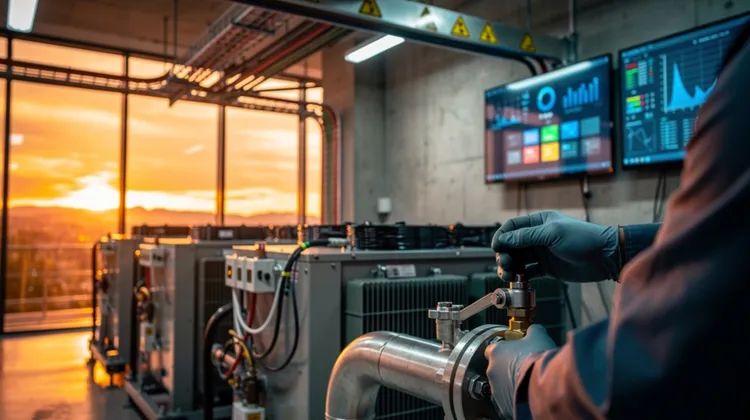
The summer of 2024 was a stark reminder that the digital world is not immune to the physical one. As thermometers shattered records across the Northern Hemisphere, the invisible infrastructure that powers modern life—the data center—found itself on the front lines of a climate crisis. The cloud, often perceived as ethereal and boundless, is tethered to concrete buildings, copper wires, and massive cooling systems that are all vulnerable to extreme heat.
For Uptime Warriors, the question is no longer if climate change will affect critical infrastructure, but how operators are engineering around the inevitable. The convergence of rising ambient temperatures, aging power grids, and the insatiable appetite of AI workloads has created a perfect storm. When the mercury climbs, the physics of cooling become brutal, and the margin for error shrinks to zero. This analysis examines the specific stress points and the strategies being deployed to keep the cloud alive when the weather turns hostile.
The Grid: A Fragile Lifeline in a Heatwave
The most immediate threat during a heatwave is not the heat itself, but its impact on the electrical grid. Air conditioning demand spikes across entire regions, pushing transmission lines to their thermal limits. For a data center, this translates into two distinct dangers: brownouts and voltage sags.
High temperatures reduce the efficiency of power transmission. When conductors heat up, they expand and sag, increasing resistance and reducing the amount of power they can safely carry. This often forces grid operators to reduce voltage by a few percentage points—a practice known as a brownout—to prevent a total blackout. For a data center filled with high-density servers, a 5% voltage reduction can cause power supplies to operate outside their optimal range, leading to premature component failure and, in worst-case scenarios, unexpected shutdowns.
Furthermore, the grid’s frequency stability is compromised when demand outpaces supply. In regions like Texas or California, where renewable penetration is high but firm capacity is limited, a sudden loss of wind or solar during a peak evening heatwave can trigger load-shedding events. Data centers, which are often seen as large, non-essential loads, can be the first to be curtailed if they are not on dedicated substations. The reliability of the grid is no longer a given; it is a variable that must be modeled, monitored, and mitigated against with on-site generation and sophisticated power management.
The Cooling Paradox: Fighting Heat with Heat
The second, more insidious challenge is the cooling system itself. Traditional Computer Room Air Conditioning (CRAC) and Computer Room Air Handler (CRAH) units rely on a simple principle: rejecting heat to the outside air. This works flawlessly in temperate climates. However, when the ambient temperature exceeds the design threshold—typically around 35°C (95°F)—the efficiency of these systems plummets.
This creates a paradox. To cool the servers, the compressors and chillers must work harder, consuming more electricity. That increased consumption generates more heat in the mechanical room and places additional strain on the already stressed grid. If the cooling system uses evaporative cooling (adiabatic), high humidity combined with heat can render the process ineffective, as the air is already saturated with moisture and cannot absorb more. The result is a rapid rise in return air temperatures, which can trigger thermal shutdowns in servers as their internal sensors hit critical limits.
The industry is moving away from a reliance on ambient air, but the transition is slow and capital-intensive. Operators are increasingly looking at "free cooling" only as a supplementary strategy, not a primary one. The focus has shifted to resilience over efficiency, meaning that systems are now being designed to operate at higher temperatures for extended periods, even if it means running at lower efficiency. This involves upgrading to variable frequency drives (VFDs), implementing advanced thermal storage (such as chilled water tanks), and, most critically, adopting liquid cooling.
Liquid Cooling: The New Reliability Imperative
Direct-to-chip and immersion cooling are no longer just for high-performance computing (HPC) enthusiasts; they are becoming a necessity for standard enterprise workloads in heat-prone regions. Liquid cooling is fundamentally more efficient because water has a much higher specific heat capacity than air. It can remove heat at the source, eliminating the need for massive air handling units and allowing for higher rack densities.
From an uptime perspective, liquid cooling offers a distinct advantage: it is less susceptible to ambient temperature fluctuations. A water loop at 25°C (77°F) will still effectively cool a chip even if the outdoor air is 45°C (113°F). This decouples the data center’s operational stability from the external climate, a significant shift in reliability engineering.
However, liquid cooling introduces its own risks. A leak in a distribution manifold can be catastrophic. This requires a higher level of monitoring and maintenance, including leak detection sensors at every junction and robust containment strategies. For the Uptime Warrior, this means a shift from monitoring server temperatures to monitoring fluid flow rates, pressure differentials, and coolant quality. It also requires a more sophisticated Building Management System (BMS) that can correlate mechanical data with IT loads in real-time.
Battery Storage and Microgrids: Decoupling from the Weather
To address the grid instability, data centers are increasingly looking at behind-the-meter storage and microgrid controls. Lithium-ion battery storage is not just for bridging the gap between a utility failure and generator startup; it is now being used for peak shaving and frequency regulation.
During a heatwave, utility prices can skyrocket. A data center with a large battery bank can discharge during peak hours, avoiding costly demand charges and reducing strain on the grid. More importantly, these batteries can act as a buffer against voltage sags. In the event of a grid frequency drop, the battery inverters can respond in milliseconds, providing instantaneous power that prevents servers from seeing the disturbance.
This creates a more resilient architecture. By pairing on-site solar, battery storage, and high-efficiency generators, a facility can operate in island mode for extended periods, completely immune to the grid’s heatwave-induced fragility. The challenge is the software. Managing these diverse energy assets requires a microgrid controller that can predict load, weather, and price signals to optimize for stability, not just cost.
Operational Strategy: The Human and Process Element
Technology is only half the battle. The most critical component of heatwave resilience is operational discipline. Pre-season testing of all cooling equipment is non-negotiable. Filters must be replaced, refrigerant levels checked, and condenser coils cleaned. A dirty coil can reduce heat rejection efficiency by up to 30%, a failure that only becomes apparent when it is too late.
Furthermore, operators must adopt a "load-shedding" playbook. This involves identifying non-critical workloads that can be temporarily suspended or migrated to other regions during extreme heat events. This is not a CTO-level decision made in the moment; it is a pre-planned, automated policy that the IT and facilities teams execute together. By reducing the IT load by 10-15% during a heatwave, the cooling system can maintain lower temperatures, protecting the integrity of the entire facility.
Finally, communication with the utility provider is essential. Large data centers often have dedicated account managers at the power company. During a heatwave, these lines of communication become vital. Operators need advance warning of potential rotating outages or voltage reductions to execute their response plans effectively. This proactive engagement is a hallmark of a mature uptime strategy. The data center is no longer a passive consumer of electricity; it is an active participant in the energy ecosystem, negotiating its position in a climate-constrained world.