
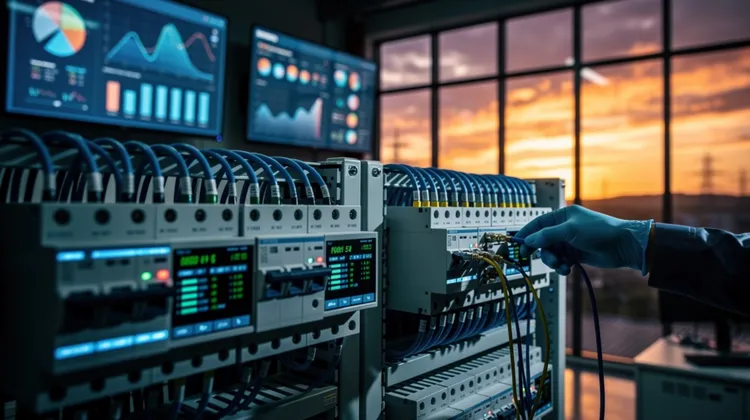
The electrical substation is the nervous system of the power grid. For decades, these critical nodes have relied on copper wiring, hardwired logic, and electromechanical relays to detect faults, isolate sections, and restore service. But as the grid evolves into a smarter, more dynamic entity, the limitations of this legacy approach have become increasingly apparent. The transition to IEC 61850, a global standard for communication in substations, is more than an upgrade—it’s a fundamental rethinking of how protection, control, and monitoring systems operate.
This shift is not merely about replacing cables with fiber optics. It’s about enabling a new level of speed, flexibility, and intelligence that hardwired systems simply cannot match. For utilities and industrial operators managing critical infrastructure, understanding the technical and operational advantages of IEC 61850 is essential for maintaining reliability in an era of distributed energy resources and increasing cyber threats.
The Hardwired Legacy: A Bottleneck for Modern Substations
Traditional substation automation relies on a point-to-point wiring architecture. Each protection relay, circuit breaker, transformer, and control panel is connected by individual copper cables. This approach has served the industry well for over a century, but it comes with significant drawbacks.
- Wiring Complexity: A typical medium-voltage substation can require hundreds of kilometers of copper cable. This not only drives up material costs but also creates immense complexity during installation, testing, and maintenance.
- Slow Response Times: Hardwired systems rely on discrete logic circuits and electromechanical timers. While reliable, they lack the speed and precision of digital communication. Fault detection and isolation can take tens of milliseconds longer than necessary.
- Limited Flexibility: Any change to protection schemes or control logic requires physical rewiring. This makes it difficult to adapt to changing grid conditions, integrate new equipment, or implement advanced protection algorithms.
- Diagnostic Challenges: Troubleshooting a hardwired system often involves tracing individual wires, checking physical contacts, and manually verifying logic. This is time-consuming and error-prone, especially in older substations.
IEC 61850: The Digital Foundation
IEC 61850 is not just a communication protocol; it’s a comprehensive framework that defines how devices in a substation exchange information. It standardizes data models, communication services, and configuration language, enabling interoperability between equipment from different manufacturers.
The core of IEC 61850 is its object-oriented data model. Instead of sending raw voltage or current values, devices communicate using standardized logical nodes—such as XCBR for a circuit breaker or PTOC for a protection function. This means that a relay from one vendor can seamlessly communicate with a bay controller from another, as long as both conform to the standard.
Key Communication Services
IEC 61850 defines several communication services, each optimized for specific tasks:
- GOOSE (Generic Object-Oriented Substation Event): This is the most critical service for protection. GOOSE messages are multicast, high-speed, and deterministic. They can trip a breaker in under 4 milliseconds, rivaling the speed of hardwired connections. GOOSE replaces the need for physical copper wires between relays for interlocking, blocking, and tripping signals.
- MMS (Manufacturing Message Specification): This is used for slower, more data-intensive tasks like SCADA communication, event logging, and parameter setting. MMS provides a standardized way to read and write data from any device on the network.
- SV (Sampled Values): This service digitizes analog measurements from current and voltage transformers. SV streams are sent over the network, eliminating the need for dedicated analog wiring to merging units.
Faster Protection Response Times: The GOOSE Advantage
The most compelling benefit of IEC 61850 is the dramatic reduction in protection response times. In a hardwired system, a trip signal from a relay to a circuit breaker travels through a dedicated copper wire. This wire has inherent resistance, capacitance, and inductance that can introduce delays, especially over long distances. Additionally, the signal must pass through auxiliary contacts, terminal blocks, and sometimes multiple relays.
GOOSE messages, on the other hand, travel over a high-speed Ethernet network. The message is encapsulated in a data packet and transmitted in microseconds. The receiving device can process the message and initiate a trip in under 4 milliseconds. This is comparable to, and in many cases faster than, hardwired connections.
- Sub-cycle Tripping: In high-voltage applications, where fault clearing must occur within a few cycles (50 or 60 Hz), GOOSE enables sub-cycle tripping. This reduces stress on equipment and minimizes the risk of arc flash.
- Peer-to-Peer Communication: GOOSE enables direct communication between relays without the need for a central controller. This reduces latency and eliminates a single point of failure.
- Redundancy: IEC 61850 supports redundant network topologies (e.g., PRP or HSR) that ensure no single point of failure can disrupt protection signals.
Reduced Wiring Complexity: A Tangible Benefit
The reduction in wiring is one of the most immediately visible advantages of IEC 61850. Instead of running hundreds of copper cables, a substation can be connected with a single fiber optic backbone. This has several practical implications.
- Lower Material Costs: Fiber optic cable is cheaper than copper, and the elimination of thousands of terminations reduces costs further.
- Simplified Installation: A single Ethernet cable can replace dozens of individual wires. This reduces installation time and labor costs.
- Easier Maintenance: Troubleshooting a network is far simpler than tracing a physical wire. Engineers can use network diagnostic tools to identify faults, monitor traffic, and analyze performance.
- Scalability: Adding a new protection relay or control device is as simple as connecting it to the network and configuring its logical nodes. No new wiring is required.
Engineering and Configuration: The New Challenge
While IEC 61850 simplifies physical wiring, it introduces a new layer of complexity: configuration. The standard uses a Substation Configuration Language (SCL) to describe the topology, devices, and data flows. This requires engineers to create a detailed model of the substation before any equipment is installed.
- System Configuration Tool (SCT): A dedicated software tool is used to create the SCL file, which defines the logical nodes, data sets, and GOOSE messages for every device.
- Interoperability Testing: While IEC 61850 ensures interoperability, it does not guarantee it out of the box. Utilities must test devices from different vendors to ensure they communicate correctly.
- Training: Engineers and technicians need training in network configuration, cybersecurity, and SCL syntax. This is a significant investment for many organizations.
Cybersecurity in the Digital Substation
The transition to a fully digital substation introduces new cybersecurity risks. A hardwired system is physically isolated; an attacker would need direct access to the copper wires. A network-based system, however, is vulnerable to cyber attacks if not properly secured.
IEC 61850 includes security measures, such as authentication and encryption for GOOSE messages, but these are not always implemented by default. Utilities must adopt a defense-in-depth approach, including network segmentation, firewalls, intrusion detection systems, and regular security audits.
The Future: Beyond the Substation
IEC 61850 is not just for substations. The standard is increasingly being used in renewable energy plants, industrial facilities, and even data centers. As the grid becomes more decentralized, the ability to communicate quickly and reliably between distributed assets will be critical.
- Integration with DER: IEC 61850 can be used to monitor and control distributed energy resources like solar panels and battery storage, enabling faster response to grid imbalances.
- Condition-Based Maintenance: The standard’s rich data model allows for detailed condition monitoring, enabling predictive maintenance and reducing unplanned downtime.
- Standardization Across Utilities: As more utilities adopt IEC 61850, the industry moves closer to a truly interoperable grid, where devices from different manufacturers can work together seamlessly.
The transition from hardwired logic to IEC 61850 is not a matter of if, but when. The benefits in speed, flexibility, and cost are too significant to ignore. For operators of critical infrastructure, the time to start planning for this digital transformation is now.